Русский
 Français
 بالعربية
 Español
Capitalizing on the Smart Pool Lighting Market: A Guide for Commercial Project Specifiers
Commercial Smart Pool Lighting Systems: Successful integration into aquatic facilities requires moving beyond aesthetic appeal to prioritize infrastructure reliability. This involves utilizing hermetically sealed, resin-potted electronics, robust communication protocols like DMX/RS485, and adherence to strict energy-efficiency mandates to ensure long-term performance and reduced facility maintenance costs.
The Commercial Challenge: Beyond Aesthetics
In the commercial aquatic sector, lighting is no longer merely a visual enhancement; it is a critical system component. For MEP consultants and project managers, the shift from basic illumination to integrated smart systems necessitates a rigorous focus on operational uptime. Unlike residential environments, public facilities face extreme stressors: constant water agitation, high chemical concentrations, and massive, multi-zone electrical requirements. Systems that fail to integrate properly often lead to signal latency, flicker, and, ultimately, expensive downtime.
Engineering Reliability: Sealing and Corrosion
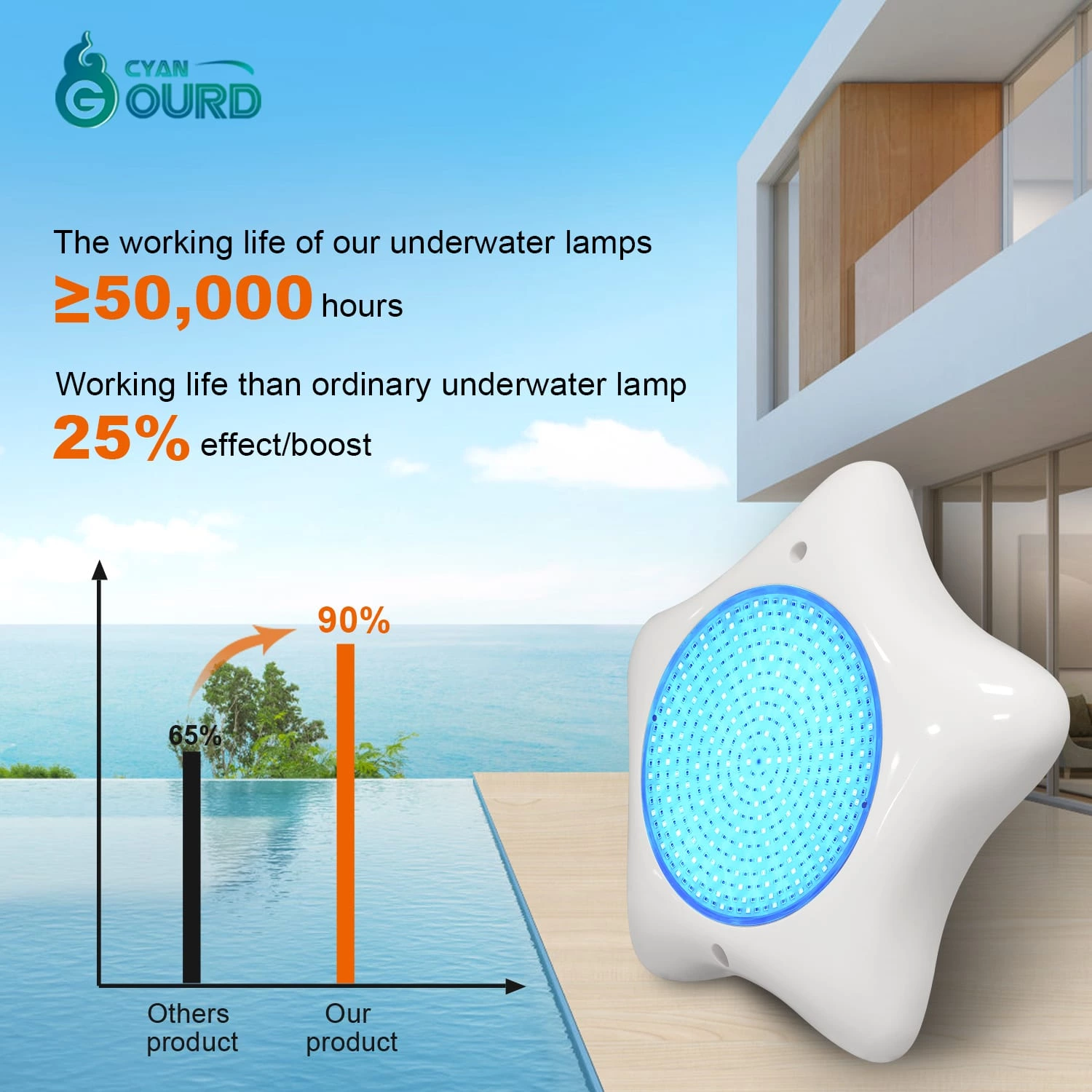
Reliability starts at the molecular level of the fixture. In our manufacturing process, we utilize high-precision resin potting to create hermetically sealed electronics. This process ensures IP68 performance that far exceeds standard gasket-reliant designs, which are prone to thermal expansion failure. For example, our Nicheless Pool Light (Model QR-55) features a compact diameter of 55mm, optimized for seamless wall mounting, while maintaining the same resin-potted integrity required for high-pressure environments. Furthermore, we validate our materials against ASTM standards for 316L stainless steel, ensuring that housings withstand the corrosive nature of saltwater and high-chlorine pools for years rather than months.
Solving the Connectivity Gap: Managing Interference
A primary failure point in large-scale installations is electromagnetic interference (EMI) within long conduit runs. To achieve stable smart lighting, project specifiers must treat the cabling as a critical engineering path. We have documented signal stability data confirming that shielded twisted-pair cabling, when integrated with robust power repeaters, prevents the flickering commonly seen in low-quality setups. Understanding the nuance of Engineering High Performance Smart Pool systems means prioritizing data integrity from the control gateway to the final node.
Smart Control Protocols and Load Balancing
For Olympic-sized or resort-complex footprints, simple on-off switches are insufficient. Industry-standard communication protocols like DMX512 or RS485 allow for granular, node-level management. This enables facility managers to adjust light levels across massive volumes of water without overloading the power grid. By segmenting the aquatic space into logical zones, facility staff can achieve sophisticated light shows or energy-conserving night modes without the instability often found in legacy analog dimming systems.
Compliance and Energy Mandates
Modern public tenders now demand strict adherence to illumination standards like IESNA RP-33, which governs lighting uniformity in swimming pools. Smart systems must be programmed not just for color, but for energy distribution that minimizes surface glare and shadow depth. Our accelerated life-cycle test (ALT) data for LED driver longevity under extreme humidity confirms that our units maintain consistent output levels even as ambient conditions fluctuate, ensuring the facility remains compliant with local energy-saving benchmarks throughout its operational lifecycle.
Partnering for Project Lifecycle Value
Maintenance is the single highest hidden cost in commercial lighting. By adopting a modular approach, such as our Stainless Steel Pool Light series, facility managers benefit from extended service intervals and modular repairability. Instead of replacing an entire housing due to minor internal component wear, modular units allow for targeted updates. This design philosophy directly addresses the pain points of long-term asset management in public sector aquatic projects.
| Feature | Standard Consumer Grade | Commercial Industrial Grade |
|---|---|---|
| Housing Material | ABS Plastic / Gasket | 316L Stainless Steel / Resin-Potted |
| Control Protocol | Bluetooth / WiFi | DMX512 / RS485 Hardwired |
| Serviceability | Disposable unit | Modular repairability |
Need Technical Specification Support?
Download our commercial integration guide or request a consultation for your aquatic facility project.
Request Technical ConsultationSelecting a Long-Term Integration Partner
Successful lighting implementation is a collaborative process. We encourage project managers to evaluate partners not on price, but on demonstrated capacity to support high-reliability infrastructure. By selecting a manufacturer that provides clear technical documentation, verified testing data, and scalable, industrial-grade protocols, you ensure that your aquatic facility remains a high-value asset for decades to come.
Frequently Asked Questions
Q: How do smart pool lighting systems integrate with commercial building management systems (BMS)?
A: Integration is achieved through industry-standard communication protocols like DMX512 or RS485. These protocols translate light control signals into digital commands that BMS controllers can manage, allowing for centralized automation and energy-demand response across the entire facility.
Q: What are the specific electrical safety requirements for high-output LED pool luminaires?
A: Commercial luminaires must adhere to safety standards such as IEC 60598, which ensures protection against electric shock and moisture ingress. Using 12V or 24V DC systems combined with proper ground-fault circuit interrupter protection is standard practice to maintain safety in aquatic environments.
Q: How does localized thermal management impact the lifespan of commercial-grade underwater LEDs?
A: Effective thermal management involves using high-conductivity materials that dissipate heat directly into the water. This prevents the junction temperature of the LED chips from exceeding design limits, which significantly extends the operational lifespan and prevents color-shifting over time.
Q: What maintenance protocols are required for smart lighting nodes in chemically treated commercial pool environments?
A: While hardware is designed for longevity, routine inspections should include checking cable connections at the junction box, verifying that seals remain intact, and testing the software control gateways. Modular systems allow for quick node replacement without draining the pool or replacing entire wiring runs.
Q: Can existing DMX or 0-10V lighting control systems be retrofitted for smart pool connectivity?
A: Often, yes. If the existing conduit can accommodate the necessary cabling for digital protocols, your system can be upgraded. However, it requires a full assessment of the wiring capacity and the compatibility of the existing drivers with modern smart controllers.