Русский
 Français
 بالعربية
 Español
Colour Changing LED Pool Lights: Manufacturing Options And Control Technologies
Colour Changing LED Pool Lights: Manufacturing Options And Control Technologies
The demand for dynamic aquatic environments has driven significant innovation in the production of colour changing LED pool lights. For distributors and pool contractors, understanding the underlying manufacturing options and control technologies is essential for selecting reliable products. As a dedicated manufacturer, Cyangourd Lighting focuses on integrating high-performance RGB and RGBW chips with robust control protocols to ensure seamless synchronization and longevity. This guide explores the technical landscape of multi-colour underwater lighting, from chip selection to advanced DMX integration.
RGB vs. RGBW: LED Chip Configuration and Output
The core of any colour changing pool light lies in its LED configuration. Manufacturing standards typically categorize these into RGB (Red, Green, Blue) and RGBW (Red, Green, Blue, White). While RGB mixes colours to approximate white, the result often lacks the purity required for high-end illumination. RGBW addresses this by incorporating a dedicated white diode (Cool White or Warm White), allowing for a broader spectrum and true white illumination without colour distortion.
From a manufacturing perspective, the choice between 3-in-1 or 4-in-1 SMD (Surface Mounted Device) chips versus discrete high-power LEDs impacts thermal management and beam uniformity. High-quality wholesale fixtures utilize efficient heat dissipation substrates, such as aluminum or ceramic PCBs, to maintain colour consistency over the lifespan of the fixture.
Control Technologies: Synchronization and Signal Transmission
Achieving perfect synchronization across multiple lights is a primary challenge in pool lighting installation. Manufacturers employ various control methods ranging from simple power cycling to complex digital signals. The most basic form is the On/Off switch control, which relies on memory chips within the driver to cycle through pre-programmed modes. However, for commercial projects requiring precise timing, digital communication is preferred.
External control systems often use Power Line Communication (PLC) or dedicated signal wires (4-wire or 5-wire systems). PLC allows control signals to travel over the existing 2-wire 12V power lines, simplifying retrofits, while multi-wire systems offer higher stability for complex light shows.
DMX512 Integration for Commercial Applications
For hotels, resorts, and municipal fountains, DMX512 (Digital Multiplex) is the industry standard. Manufacturing DMX-compatible pool lights requires integrating specialized decoder chips that can interpret digital packets for individual addressability. This allows lighting designers to create intricate scenes where each light operates independently or as part of a mapped grid.
Implementing DMX in underwater environments necessitates rigorous waterproofing of signal cables and connectors. We utilize VDE-certified cables and resin-filled internal structures to protect sensitive DMX decoders from moisture ingress, ensuring the system remains operational even in submerged conditions.
Waterproofing Standards and Material Durability
Colour changing electronics are more complex than static single-colour boards, making waterproofing critical. The industry standard is IP68, but the manufacturing method defines the reliability. Fully resin-filled lights, where the LED board is encapsulated in transparent epoxy or polyurethane, offer superior protection compared to traditional O-ring sealed units. This prevents water condensation caused by the thermal expansion and contraction cycles typical of high-output RGB fixtures.
Housing materials also play a role. While ABS plastics are cost-effective for residential pools, 316L stainless steel is recommended for saltwater environments to prevent corrosion that could compromise the seal and damage the control electronics.
Comparison of Control Methods for Wholesale Buyers
Selecting the right control technology depends on the project scale and budget. The table below outlines the key differences between common manufacturing options for colour changing systems.
| Control Method | Wiring Requirement | Synchronization Capability | Ideal Application |
|---|---|---|---|
| On/Off Switch | 2-Wire (AC Power) | Basic (Time-based reset) | Residential Retrofits |
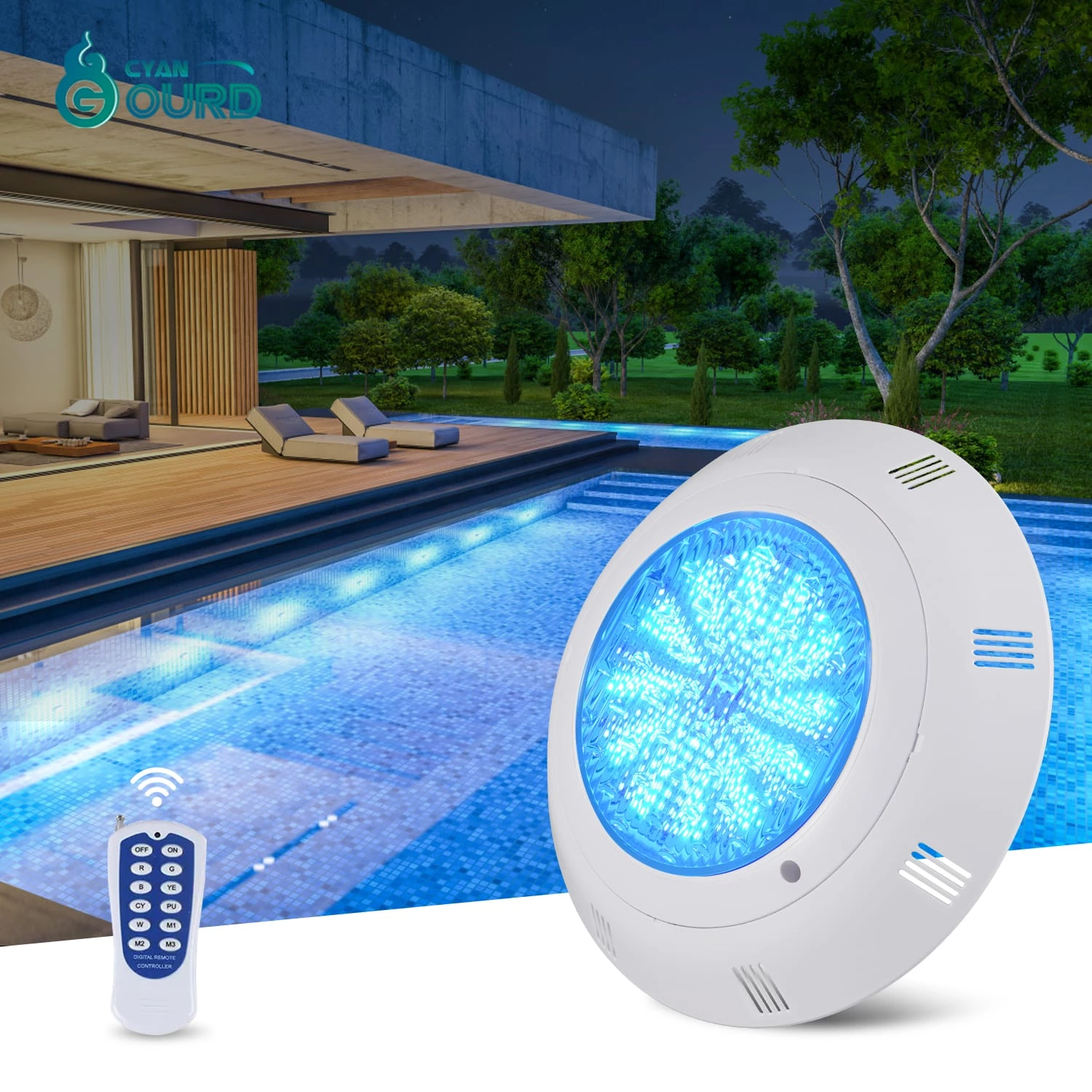
| Remote / WiFi Controller | 2-Wire or 4-Wire | High (External Controller) | Smart Homes & Luxury Pools |
| External PWM | 4-Wire (RGB) / 5-Wire (RGBW) | Perfect (Hardwired) | New Construction |
| DMX512 | 3-Wire or 5-Wire (Data+Power) | Advanced (Individual Address) | Commercial & Water Features |
OEM Customization for Colour Changing Systems
As a factory-direct supplier, Cyangourd Lighting offers extensive customization for colour changing LED pool lights. OEM clients can specify the exact wavelength of LEDs, the type of control chip used, and the length of the cable to suit specific market needs. Whether requiring a proprietary remote control frequency or compatibility with third-party automation systems like Crestron or Pentair, our engineering team can adapt the internal circuitry to meet these specifications.
Frequently Asked Questions
-
1. What is the difference between 2-wire and 4-wire RGB pool lights?
2-wire lights typically use internal drivers or power line communication for colour changing, making them ideal for retrofitting existing pools. 4-wire lights use separate wires for Red, Green, Blue, and Common Positive (V+), requiring an external controller but offering more stable synchronization.
-
2. Can Cyangourd Lighting manufacture DMX-compatible pool lights?
Yes, we manufacture DMX512 compatible underwater lights. These units feature built-in decoders and are designed for commercial applications requiring complex light shows and integration with central control systems.
-
3. How do you ensure synchronization between multiple colour changing lights?
Synchronization is achieved through consistent control protocols. For switch-control models, we use memory chips with precise timing. For external control models, all lights receive the same signal simultaneously from a central RGB controller or DMX master.
-
4. Are your RGB pool lights suitable for saltwater pools?
Yes, provided the correct material is selected. We recommend our 316L stainless steel or high-grade ABS plastic fixtures for saltwater environments to prevent corrosion. All our lights are IP68 rated and resin-filled for maximum protection.
-
5. What voltage options are available for colour changing lights?
Our standard manufacturing output is AC/DC 12V or 24V low voltage, which is the safety standard for underwater lighting. We can customize the voltage input based on regional safety regulations and transformer compatibility.