Русский
 Français
 بالعربية
 Español
Common Misconceptions About Pool Lighting From a Manufacturer’s Perspective
Common Misconceptions About Pool Lighting From a Manufacturer’s Perspective
In the wholesale swimming pool lighting industry, misinformation can lead to costly procurement errors, installation failures, and increased warranty claims. As a dedicated manufacturer of LED pool lights, Cyangourd Lighting frequently encounters misunderstandings regarding technical specifications, material durability, and waterproofing standards. By clarifying these misconceptions, distributors and contractors can make more informed sourcing decisions that ensure long-term reliability and safety for end-users.
Myth 1: Higher Wattage Always Equals Brighter Light
One of the most persistent myths in the lighting industry is that wattage is the sole indicator of brightness. In the era of incandescent bulbs, this was generally true. However, with modern LED technology, efficiency is the key metric. A poorly engineered 35W LED light may produce fewer lumens than a high-efficiency 18W LED fixture.
From a manufacturing perspective, focusing solely on high wattage can be detrimental. Higher wattage generates more heat, which, if not dissipated correctly through the PCB and housing, can shorten the lifespan of the LED chips. We prioritize high lumen-per-watt efficiency to provide brilliant illumination while maintaining lower operating temperatures and energy consumption.
Myth 2: All "Waterproof" Lights Are Created Equal
While many pool lights carry an IP68 rating, the method used to achieve this rating varies significantly between manufacturers. A common misconception is that a rubber gasket or O-ring is sufficient for long-term underwater use. While gaskets work initially, they degrade over time due to thermal expansion and contraction cycles and exposure to pool chemicals.
True industrial-grade waterproofing often involves fully resin-filled technology. In this process, the internal components and LED drivers are completely encapsulated in a specialized epoxy resin. This eliminates air voids inside the fixture, preventing water ingress even if the outer lens is compromised. Buyers should look beyond the label and inquire about the internal sealing structure.
Myth 3: Stainless Steel Never Rusts Underwater
The assumption that any stainless steel fixture is immune to corrosion is incorrect, particularly in the context of saltwater pools. Standard 304 stainless steel is durable but susceptible to pitting and corrosion in saline environments or pools with unbalanced pH levels. This misconception often leads to aesthetic degradation and structural failure in coastal or saltwater projects.
For saltwater applications, 316L stainless steel or high-grade ABS+PC plastics are the superior choices. 316L contains molybdenum, which drastically increases corrosion resistance. As a manufacturer, we recommend matching the material grade strictly to the installation environment to avoid premature oxidation.
Myth 4: Wireless Control Signals Travel Easily Through Water
Distributors often request lights with built-in WiFi or RF receivers, assuming the signal will penetrate water as easily as it does air. Water is a highly effective attenuator of high-frequency radio waves. A standard WiFi signal is almost immediately absorbed by water, making direct wireless control of submerged fixtures unreliable or impossible without specialized equipment.
Reliable control systems typically utilize Power Line Communication (PLC) or external controllers wired to the transformer. In these setups, the control signal travels through the power cable rather than through the water. Understanding this physical limitation is crucial for planning successful smart pool lighting systems.
Myth 5: LEDs Last Forever Without Maintenance
While LEDs have a significantly longer lifespan than halogens, the idea that they are "install and forget" forever is a myth. The longevity of an LED pool light is directly tied to its thermal management and the stability of the power supply. Voltage spikes and poor heat dissipation can cause premature failure of the driver or LED chips.
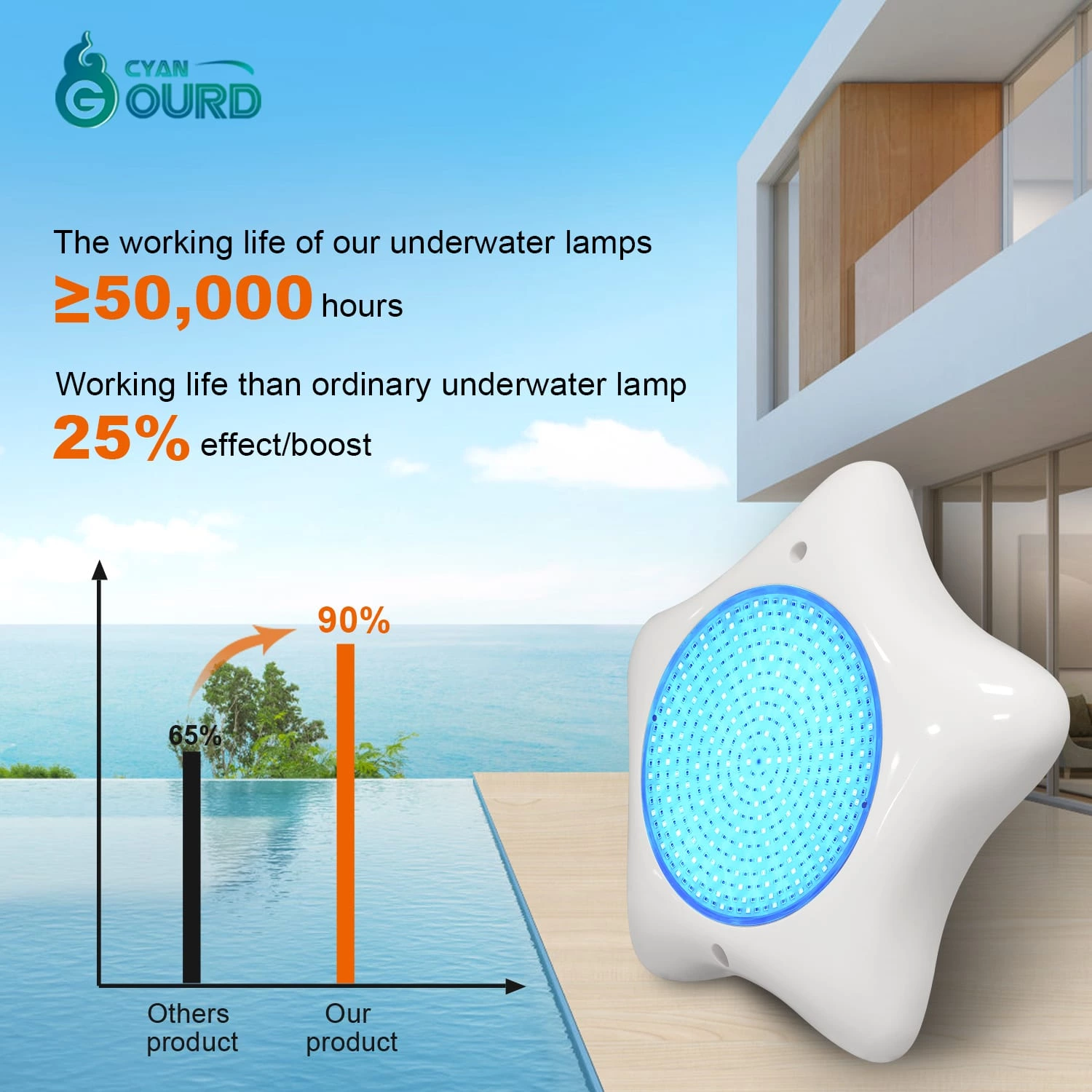
Furthermore, the waterproofing seals (if not resin-filled) require inspection. To ensure the claimed 50,000-hour lifespan, the installation must utilize stable low-voltage transformers (AC/DC 12V or 24V) and ensure the fixture is fully submerged during operation to utilize the water for cooling.
Comparison: Traditional Gasket Sealing vs. Resin-Filled Technology
| Feature | Traditional Gasket/O-Ring | Fully Resin-Filled (Epoxy) |
|---|---|---|
| Waterproofing Mechanism | Mechanical compression seal | Solid encapsulation of electronics |
| Risk of Leakage | Moderate (increases with age) | Extremely Low (Zero air voids) |
| Thermal Expansion Impact | Can loosen seal over time | Resistant to thermal cycling |
| Maintenance Requirement | Gasket replacement may be needed | Maintenance-free sealing |
| Ideal Application | Budget-friendly residential pools | Commercial & high-end projects |
Frequently Asked Questions
1. Why do manufacturers insist on 12V or 24V instead of high voltage?
Low voltage (AC/DC 12V or 24V) is a critical safety requirement for underwater lighting to prevent electrocution hazards. High voltage lines near water pose significant risks. Additionally, low voltage systems are easier to regulate for LED longevity.
2. Can I use 304 stainless steel lights in a saltwater pool?
It is not recommended. While 304 stainless steel is corrosion-resistant in fresh water, the chloride ions in saltwater pools will cause pitting and rust. For saltwater applications, we strongly advise using 316L stainless steel or durable plastic housings.
3. Does a higher IP rating guarantee the light will never leak?
IP68 is the standard for continuous submersion, but the manufacturing quality defines the reality. A resin-filled IP68 light is far more reliable than a gasket-sealed IP68 light, as the latter relies on rubber that can degrade. Always check the internal sealing method.
4. Why do my RGB lights fall out of sync?
Synchronization issues often arise from using different transformers or mixing light batches with different control chips. To ensure perfect sync, all lights should be on the same circuit, use the same control protocol (e.g., switch control or DMX), and ideally be sourced from the same production batch.
5. Is it true that LED pool lights don't produce heat?
No, this is a myth. While LEDs are cooler than incandescent bulbs, they still generate heat at the circuit board level. This heat must be dissipated into the surrounding water. Operating high-power underwater lights out of water can cause them to overheat and fail rapidly.