Русский
 Français
 بالعربية
 Español
Engineering Considerations for Luxury Resort Swimming Pool LED Lighting
Designing underwater illumination for luxury hospitality requires a shift from aesthetic-first planning to long-term operational resilience. For project engineers and MEP consultants, the primary objective is to mitigate the high costs associated with premature lighting failure, which often involves the complex and expensive process of draining massive resort pool basins. By focusing on material science, thermal management, and BMS integration, engineering teams can significantly extend maintenance cycles and ensure consistent performance across large-scale aquatic installations.
The Hidden Cost of Underwater Lighting: Why Resort Infrastructure Fails
In resort environments, the interaction between pool chemistry and electrical components is a primary driver of failure. Standard consumer-grade Led Pool Light units frequently succumb to moisture ingress or chemical-induced corrosion within 18 to 24 months. Our experience in manufacturing thousands of units confirms that failure often begins at the cable gland or the seal interface, where high pressure in deep-end applications forces water into the housing. For high-end projects like the Maldives Luxury Beach Resort Pool, we emphasize structural integrity to avoid these costly interventions.
Material Science: Choosing 316L Stainless Steel vs. Alternative Housing Materials
For saltwater pools, 316L stainless steel is the industry standard for preventing galvanic corrosion. While lesser alloys may pass initial inspections, they often degrade in the presence of fluctuating chlorine levels and salinity. Our production process involves passivation, which enhances the corrosion resistance of the chromium-oxide layer on the steel surface. Validating this durability, our units undergo rigorous salt spray testing according to ASTM B117 standards to ensure long-term stability. For instance, our Nicheless Pool Light (Model QR55) utilizes marine-grade housing specifically engineered to maintain structural and aesthetic integrity in these aggressive environments.
Optical Engineering: Achieving Uniformity and Lumen Maintenance (L70) in Large-Scale Pools
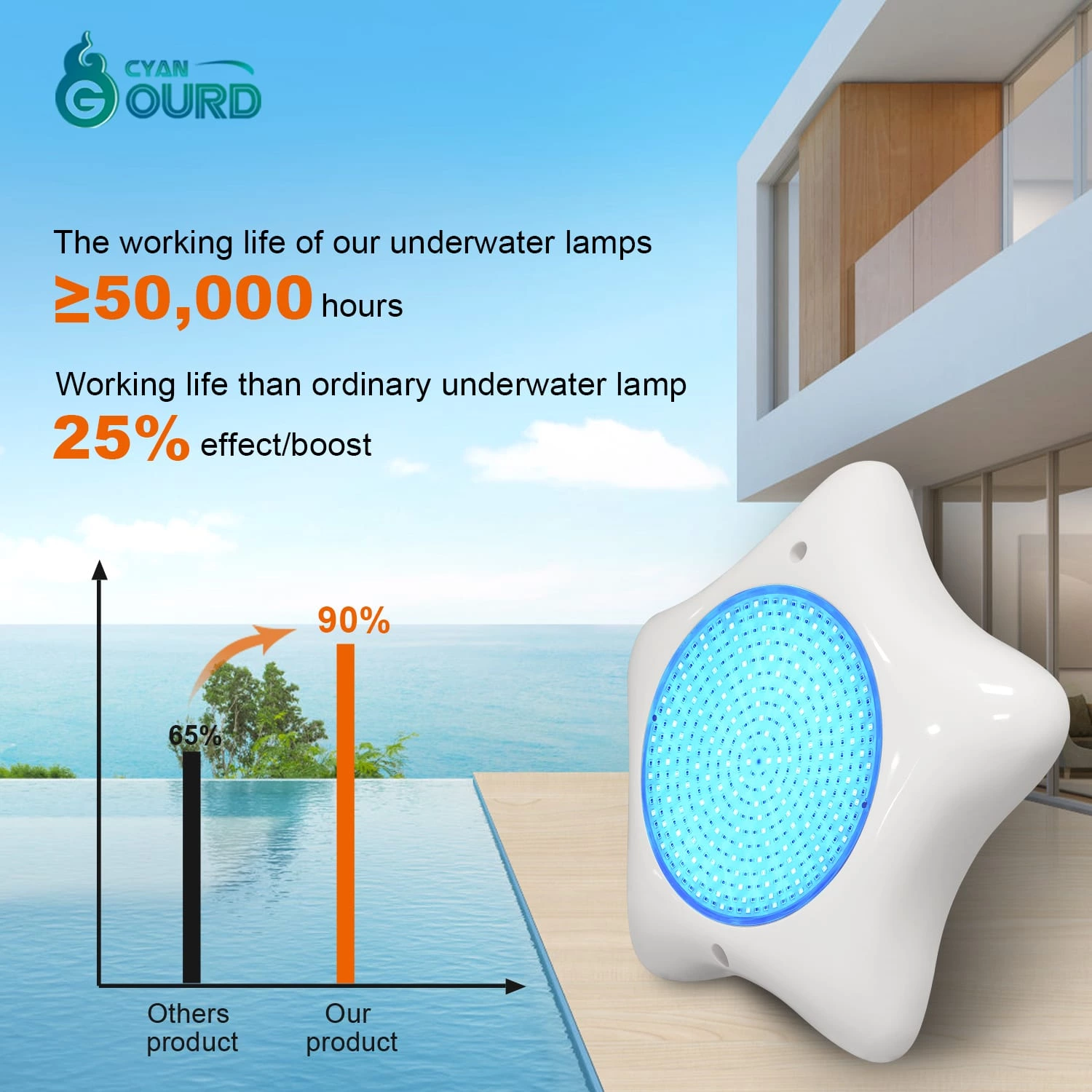
Lighting consistency across a large pool is achieved through precise color temperature binning. We implement strict binning protocols to ensure that all luminaires exhibit the same chromaticity, preventing the patchy appearance often seen in large installations. Furthermore, managing heat is critical to longevity; the Embedded Pool Light design we manufacture uses internal heat-sinking to move thermal energy away from the driver. This engineering ensures that the L70 lumen maintenance rating (the point at which the light output drops to 70 percent of its initial value) consistently exceeds 50,000 hours of operation.
Integration Architecture: Connecting LED Luminaires to Modern Building Management Systems (BMS)
Modern resorts require centralized control to manage energy consumption and automated scene scheduling. By utilizing native compatibility with DALI or KNX protocols, engineers can integrate Stainless Steel Pool Light units into a facility-wide management system. This level of control allows for automated dimming and color management, which further preserves LED lifespan and reduces overall OPEX by lowering power usage during off-peak hours.
Compliance and Safety: Navigating International Low-Voltage Standards for Aquatic Zones
Safety is the non-negotiable cornerstone of pool lighting. All installations must adhere to IEC 60598-2-18, the international standard specifically governing underwater luminaires. During our QC checkpoints, we verify that every unit is rated for safety under these low-voltage requirements. Our factory audit protocols ensure that the vacuum-sealing process for our IP68-rated fixtures is tested under high pressure, simulating depths significantly greater than standard commercial pools to ensure total watertight performance.
| Feature | Standard Lighting | Resort-Grade LED |
|---|---|---|
| Housing Material | Plastic/Polymer | Passivated 316L Stainless Steel |
| Ingress Protection | IP68 (Standard) | Vacuum-sealed, High-Pressure Tested |
| Lumen Life (L70) | 20,000 Hours | 50,000+ Hours |
| BMS Compatibility | None | Native DALI/KNX Support |
Q: What is the recommended lifespan for resort-grade underwater lights?
A: Engineers should aim for a minimum of 50,000 hours of L70 performance to align with the standard renovation cycles of luxury properties.
Q: Why is 316L steel necessary for saltwater pools?
A: 316L provides superior molybdenum-enhanced corrosion resistance, which is essential to prevent pitting in the chloride-heavy environments of modern saltwater pools.
Q: How does thermal management extend the life of a light?
A: By effectively sinking heat away from the LED driver, we prevent premature failure caused by capacitor dry-out and electronic overheating.
Q: Can existing pool lights be integrated into a new BMS?
A: It depends on the driver communication protocol; native DALI/KNX compatibility is recommended during the initial design phase for seamless integration.
Q: What standards should be referenced for electrical safety?
A: Always specify products compliant with IEC 60598-2-18, which addresses the specific risks associated with underwater luminaires.
Request Engineering Considerations Led Pool Light and Technical Spec Sheets for your next project.