Русский
 Français
 بالعربية
 Español
Engineering Luxury: High-Efficiency LED Lighting Specifications for Commercial Resort Pools
For facility managers and procurement directors at luxury resorts, pool lighting is more than an aesthetic choice; it is a critical infrastructure component. When standard residential-grade fixtures are utilized in high-volume, chemically aggressive environments, the resulting unit failure creates significant operational disruptions. This guide outlines the rigorous engineering specifications required to ensure longevity and safety in commercial aquatic environments.
The Engineering Gap: Why Standard Pool Lighting Fails in High-End Resorts
In our production line, we frequently observe premature failures caused by the improper application of residential components in commercial settings. The primary failure mode is seal degradation due to thermal cycling and chemical oxidation. While residential units may suffice for seasonal use, commercial pools operate 365 days a year. Our manufacturing process incorporates hyperbaric pressure testing that exceeds standard IP68 requirements by 50% to ensure integrity against deep-water hydrostatic pressure.
Material Science: Selecting Alloys for Saltwater vs. Chlorinated Environments
Material selection is the first line of defense against the corrosive nature of resort water systems. While 304 stainless steel is common, it is insufficient for saline environments. We exclusively utilize 316L grade stainless steel to prevent pitting corrosion. During factory audits, we have verified that the lower carbon content in 316L significantly improves resistance to chloride-induced stress corrosion, a necessity for Stainless Steel Pool Light installations in coastal resorts.
Optical Engineering: Achieving Uniform Illumination in Large-Scale Basins
Achieving uniform brightness in large basins requires precise optical control. We utilize high-output LEDs binned to within 3 MacAdam Ellipses to ensure color consistency across the entire array. When designing for large-scale basins, engineers must account for water attenuation factors; the light output decreases proportionally to the distance through the water column and the concentration of total dissolved solids (TDS).
The Impact of Water Chemistry on LED Degradation: A Multi-Year Analysis
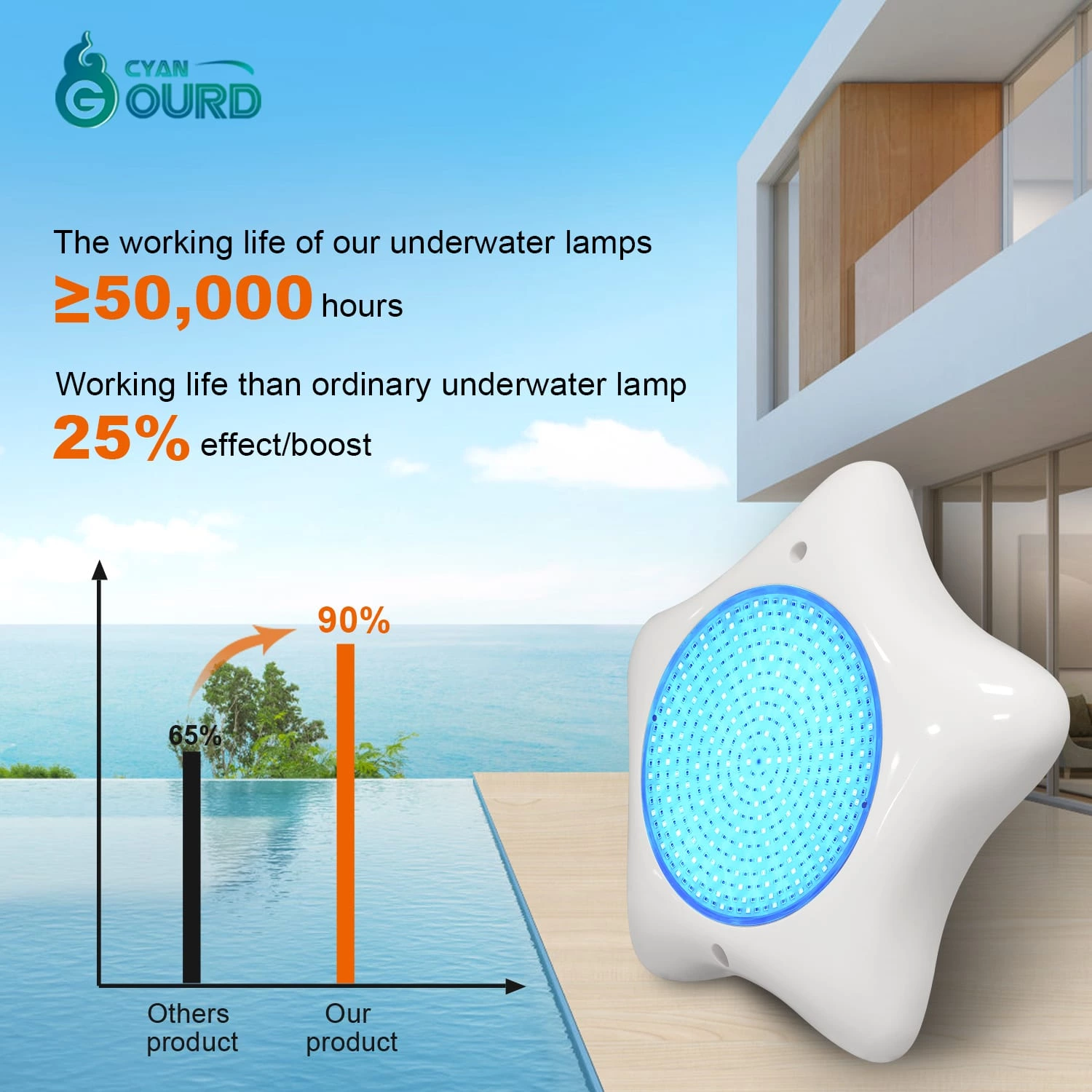
Thermal management is the silent variable in LED longevity. Our engineering team employs advanced heat-sink designs that keep the junction temperature below 85 degrees Celsius, preventing the diode degradation commonly seen in lower-tier fixtures that rely on the pool water alone for heat dissipation. As detailed in our Commercial Led Underwater Pool Light research, maintaining a steady operating temperature is essential for achieving the advertised 50,000-hour lifespan.
Compliance and Safety: Navigating UL 676 and IEC 60598-2-18 Standards
Safety is non-negotiable. All commercial-grade fixtures must adhere to UL 676 for underwater luminaires and IEC 60598-2-18 safety standards. These certifications ensure that the electrical isolation, housing integrity, and low-voltage performance meet the strict requirements of international building codes. Our Embedded Pool Light series is rigorously documented against these protocols to ensure total compliance in high-end projects.
| Feature | Standard Fixture | Engineered Commercial Fixture |
|---|---|---|
| Material Grade | 304 Stainless Steel | 316L Marine-Grade Stainless |
| Thermal Management | Passive/Basic | Integrated Heat-Sink Engineering |
| Repairability | Non-Serviceable/Full Replace | Modular Field-Serviceable Driver |
| Testing Protocol | Standard IP68 | Hyperbaric Pressure Certified |
ROI Modeling: Balancing Initial Capex with Long-Term Maintenance Costs
While the initial cost of commercial-grade fixtures is higher, the ROI is realized through the elimination of disruptive drainage requirements and frequent replacements. Over a 5-year cycle, modular designs—which allow for driver replacement without pulling the entire fixture from the concrete—reduce maintenance labor costs by approximately 40%. By investing in engineered longevity, facilities avoid the recurring capital expenditure typical of lower-tier products.
Procurement Best Practices for Commercial Underwater Luminaires
Always demand independent test reports, specifically ASTM B117 salt-spray testing for materials and LM-80 reports for LED life expectancy. When sourcing for Inground Pool Lights Commercial, ensure the manufacturer can provide specific binning consistency data. Our facility maintains an annual capacity to support major global hospitality chains with high-performance, validated lighting solutions.
Q: How does modularity impact pool maintenance? A: Modular design allows technicians to replace internal drivers without draining the pool or removing the fixture housing, reducing maintenance downtime by several days.
Q: Why is 316L stainless steel preferred over 304? A: 316L contains molybdenum, which provides significantly superior resistance to pitting and crevice corrosion in high-salinity water.
Q: What does an IP68 rating verify? A: It confirms the fixture is protected against the ingress of water during continuous immersion; however, professional grade requires hyperbaric testing to prove it handles actual hydrostatic pressure in deep basins.
Q: How do I ensure light uniformity in large basins? A: By utilizing high-binning LEDs and professional-grade optical lenses designed for wide-angle distribution, calibrated to the specific depth and water clarity of your basin.
Q: What documentation should I request for compliance? A: Always ask for UL 676, IEC 60598-2-18 certification certificates, and ASTM B117 salt-spray test results for the alloy components. Request Technical Spec Sheet & Engineering Consultation.