Русский
 Français
 بالعربية
 Español
Why Flush Mount Pool Lights are the Safest Choice for Resort and Water Park Design
For commercial aquatic facilities, lighting is more than an aesthetic feature; it is a critical infrastructure component that must withstand extreme chemical exposure and high-flow hydraulics. Conventional surface-mount lighting often introduces edge-snagging risks and maintenance hurdles that compromise both guest safety and operational budgets. By transitioning to precision-engineered Nicheless Pool Light systems, facility managers can mitigate entrapment risks while significantly reducing service frequency.
The Hidden Cost of Surface-Mount Lighting in Resort Facilities
Traditional surface-mount systems rely on recessed housings that create water cavities, which are notorious for debris accumulation and biofilm growth. In high-traffic resort environments, these housing gaps can lead to structural damage when heavy cleaning equipment or turbulent water flow causes vibration. Furthermore, the protrusion of traditional fixtures creates potential snag points, a primary concern for meeting aquatic safety standards regarding underwater entrapment.
Engineering Safety: Hydrodynamics and Flush-Fit Design
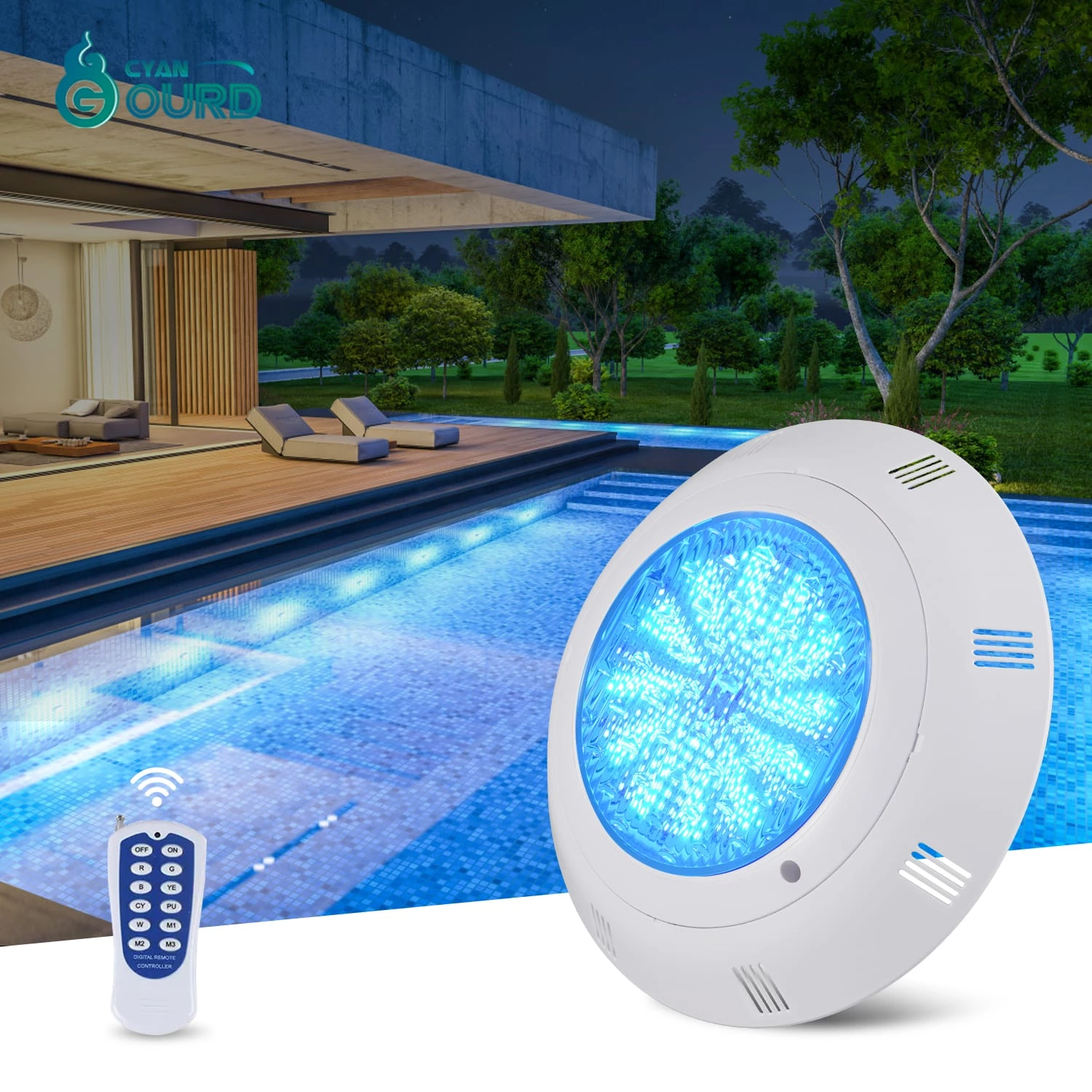
True hydrodynamic lighting design focuses on low-profile, zero-gap integration with the pool wall. During our manufacturing process, we utilize precision-milled housing to ensure that the luminaire face remains perfectly flush with the wall surface, preventing the turbulent water vortices that lead to light-to-wall friction and seal degradation. Unlike decorative flush mounts, our performance-grade Embedded Pool Light systems are specifically designed to eliminate sharp edges that could pose entrapment risks under high-flow suction conditions.
Material Science for High-Traffic Environments
While residential installations often utilize 316L stainless steel, commercial resort facilities demand superior material stability against constant hyper-chlorination. Our Abs Pool Light solutions leverage proprietary chlorine-resistant polymer blends rather than standard plastics. These polymers are engineered to resist embrittlement and discoloration under prolonged ultraviolet exposure and chemical stress, ensuring the structural integrity of the seal throughout the product lifecycle.
Operational Efficiency: Impact on Maintenance Cycles
Maintenance access is a critical KPI for any large-scale aquatic facility. Surface-mount fixtures often require pool drainage or complex diversions to service, leading to significant downtime. In contrast, nicheless flush mount systems such as our Model QR-55 (Product Dimensions φ55*H110mm) allow for simplified replacement protocols. By integrating these systems, facility managers achieve a measurable reduction in service frequency, thanks to the robust, factory-tested sealing protocols applied to every 3W/6W/9W unit.
| Feature | Surface-Mount Housing | Flush Mount (Nicheless) |
|---|---|---|
| Hydrodynamic profile | High turbulence/drag | Low-drag/flush-fit |
| Debris accumulation | High risk | Minimal |
| Maintenance access | Complex (Housing based) | Simplified/Direct |
Compliance and Rigorous Testing
All commercial lighting must adhere to strict safety regulations, specifically NEC Article 680 regarding underwater luminaires and entrapment protection. Our production lines subject units to rigorous testing, including IP68 and IEC 60598-2-18 protocols. We provide documented UL 676 safety certification, ensuring that our units meet the necessary electrical insulation and mechanical strength requirements for public use.
Case Study: Stress Test Summary
To ensure long-term reliability, we maintain an anonymized lab stress test database. Our testing protocol involves 5,000 hours of continuous immersion in a hyper-chlorinated environment (5.0 ppm) to simulate years of harsh operating conditions. Units consistently maintain IP68 watertight integrity throughout this duration, confirming that the polymer-to-sealing interface is sufficient for the high-volume, high-heat environments typical of modern resort pools.
Q: How does flush mount design reduce entrapment hazards?
A: By eliminating the gap between the fixture and the pool wall, flush mount lighting removes potential points of contact where a swimmer's hair or jewelry could snag, satisfying key NEC Article 680 safety requirements.
Q: Are flush mount lights compatible with existing surface-mount wiring?
A: Most nicheless flush mount systems are designed for flexible retrofitting, though we recommend consulting with an MEP engineer to ensure the conduit and junction box meet local voltage standards.
Q: What is the benefit of the polymer material vs 316L stainless steel?
A: While 316L is durable, high-end chlorine-resistant polymers prevent the galvanic corrosion common in stainless steel fixtures when used in aggressive pool water chemistries.
Q: How do I verify IP68 compliance for my procurement audit?
A: Ensure that the supplier provides a verifiable test certificate that references IEC 60598-2-18, confirming that the luminaire was tested for full submersion at its rated depth.
Q: Why does the flush mount design improve maintenance?
A: Because these units are designed as an integrated component without recessed niches, technicians can remove and replace the entire unit or light source without disturbing the pool shell structure or requiring specialized dive teams.