Русский
 Français
 بالعربية
 Español
Nicheless vs Traditional Pool Lights: Manufacturing Trade-Offs in Cost, Safety, and Installation Flexibility
Nicheless vs Traditional Pool Lights: Manufacturing Trade-Offs in Cost, Safety, and Installation Flexibility
In the wholesale swimming pool lighting market, the transition from traditional niche-based fixtures to modern nicheless LED designs represents a significant shift in manufacturing philosophy and installation logic. For distributors and pool construction professionals, understanding the trade-offs between these two distinct categories is essential for inventory planning and project specification. While traditional wet-niche lights have been the industry standard for decades, nicheless technology offers distinct advantages in terms of structural integrity, safety, and installation versatility. This analysis explores the manufacturing differences, cost implications, and safety factors that influence the choice between nicheless and traditional pool lighting systems.
1. Structural Differences and Manufacturing Complexity
The primary distinction lies in the housing architecture. Traditional pool lights require a large "wet niche"—a stainless steel or plastic bucket embedded into the pool wall during the gunite or concrete phase. The light fixture is then sealed with a gasket and screwed into this niche. From a manufacturing standpoint, this requires producing multiple heavy components: the niche bucket, the fixture housing, and the face ring.
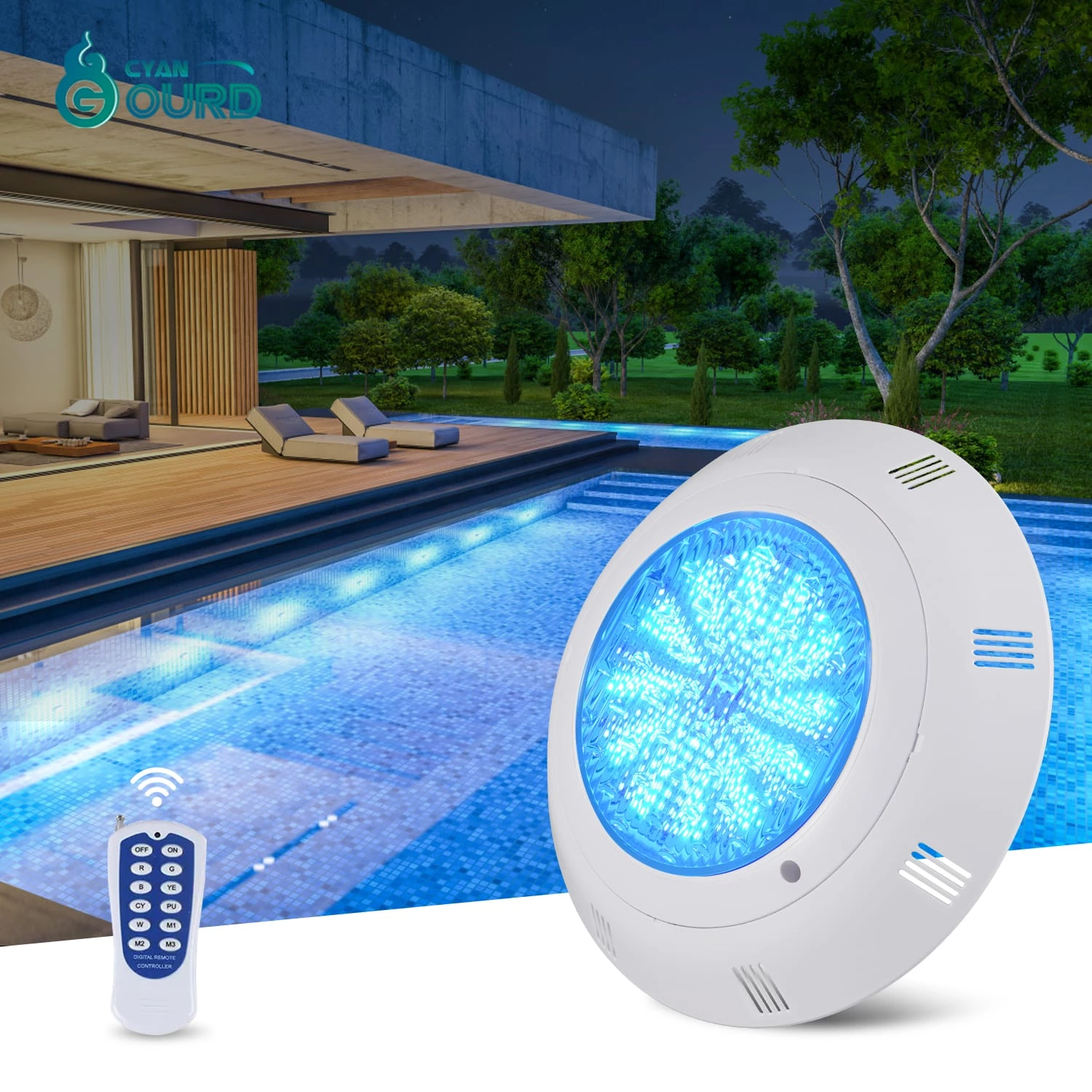
Conversely, nicheless LED lights are designed to mount directly into standard 1.5-inch wall fittings or conduit pipes. They eliminate the need for the bulky niche bucket. Manufacturers like Cyangourd Lighting utilize compact, fully resin-filled structures for nicheless lights. This reduces raw material usage (specifically stainless steel) and simplifies the assembly line by integrating the LED board, driver, and waterproofing into a single, slim unit. This streamlined manufacturing process often results in lower defect rates compared to the multi-part assembly of traditional fixtures.
2. Cost Analysis: Production vs. Installation
When analyzing costs for B2B procurement, it is vital to separate unit cost from total installed cost. Traditional niche lights often carry a higher total material cost because the contractor must purchase the niche housing separately from the light fixture. Additionally, the shipping weight of traditional stainless steel niches adds to logistics expenses.
Nicheless lights, being compact and lightweight, offer significant savings in logistics and storage. However, the manufacturing cost of high-quality nicheless lights can be influenced by the grade of resin and the thermal management technology used. While the unit price of a premium nicheless LED might be comparable to a PAR56 bulb and housing, the elimination of the niche bucket and the reduction in labor time for installation typically make nicheless systems more cost-effective for the end contractor, driving demand at the wholesale level.
3. Waterproofing Reliability: Resin-Filled vs. Gaskets
Waterproofing failure is the leading cause of warranty claims in the pool lighting industry. Traditional lights rely on a mechanical seal—a rubber gasket compressed by a clamp or screws. Over time, heat cycles and chemical exposure can degrade this gasket, leading to water intrusion.
Nicheless lights manufactured by Cyangourd prioritize a fully resin-filled structure. By encapsulating the PCB and LEDs in a specialized epoxy or polyurethane resin, the light achieves an IP68 rating without relying on mechanical seals. This solid-state construction eliminates air gaps where condensation could form, significantly enhancing longevity and safety. For distributors, stocking resin-filled nicheless lights often translates to fewer returns and higher customer satisfaction.
4. Installation Flexibility and Retrofitting
Installation flexibility is a major selling point for nicheless designs. Traditional niches must be installed during the initial construction phase; if a niche is crooked or positioned incorrectly, correcting it involves chipping out concrete. This rigidity limits design changes later in the project.
Nicheless lights fit into standard return fittings, which are ubiquitous in pool construction. This allows builders to place lights on steps, sun shelves, or in shallow water features where a large niche would be structurally impossible. Furthermore, nicheless lights are ideal for retrofitting older pools. Manufacturers offer adapter plates that allow slim nicheless lights to be mounted over existing damaged niches, providing a modern LED solution without major renovation work.
5. Thermal Management and Safety Standards
Heat dissipation is critical for LED lifespan. In a traditional wet niche, water circulation around the fixture can be poor, leading to stagnant, hot water that shortens the life of the LED driver. Nicheless lights, protruding slightly or sitting flush with the wall, are constantly exposed to the pool's water circulation, ensuring efficient cooling.
From a safety perspective, both systems utilize low-voltage (12V or 24V) transformers. However, the compact nature of nicheless lights often requires external drivers or highly integrated internal drivers that adhere to strict thermal cut-off standards. Using materials like 316L stainless steel or high-grade ABS+PC ensures that the housing can withstand the thermal expansion and contraction cycles without cracking.
Comparison: Nicheless vs. Traditional Pool Lights
| Feature | Traditional (Wet Niche) | Nicheless (Resin-Filled) |
|---|---|---|
| Installation Requirement | Requires large embedded bucket (niche) | Fits standard 1.5" pipe or wall fitting |
| Waterproofing Method | Mechanical gasket and clamp | Fully resin-filled (Solid State) |
| Cooling Efficiency | Limited water flow inside niche | Direct contact with circulating pool water |
| Material Usage | High (Large SS/Plastic housing) | Low (Compact design, less waste) |
| Application | Deep ends, main pool illumination | Steps, shelves, spas, and main pools |
Frequently Asked Questions
-
1. Are nicheless pool lights brighter than traditional niche lights?
Not necessarily brighter, but often more efficient. While traditional large PAR56 bulbs can produce high lumen output, modern nicheless LEDs use high-efficacy chips to deliver comparable brightness with lower wattage. For large commercial pools, multiple nicheless lights are often used to provide more even light distribution than fewer, high-intensity traditional lights.
-
2. Can nicheless lights be installed in a pool that was built for traditional lights?
Yes, retrofitting is a common application. Manufacturers provide retrofit kits or adapter plates that allow a slim nicheless light to mount over an existing niche or attach to the conduit line inside the niche, upgrading the pool to LED without removing the old bucket.
-
3. Why is resin-filled technology preferred for nicheless lights?
Resin-filling creates a solid block that completely isolates the internal electronics from water. This eliminates the risk of gasket failure, which is the primary weakness of traditional air-filled housings. It ensures a consistent IP68 rating suitable for long-term submersion.
-
4. Do nicheless lights require special transformers?
Most nicheless lights operate on standard 12V AC or DC low voltage, compatible with existing pool transformers. However, it is crucial to match the voltage type (AC vs. DC) and ensure the transformer has sufficient wattage capacity for the total number of fixtures installed.
-
5. How does the cost of nicheless lights compare to traditional lights for wholesalers?
While the per-unit cost of a high-quality nicheless fixture may be similar to a traditional bulb-and-housing combo, the elimination of the niche bucket reduces the overall Bill of Materials (BOM) for the project. Additionally, reduced shipping weight and volume offer logistical savings for wholesale importers.