Русский
 Français
 بالعربية
 Español
Technical Specification Guide: Narrow-Beam Commercial Fountain Lighting
Specifying high-performance illumination for large-scale municipal and hospitality water features requires moving beyond residential-grade solutions. In commercial hydraulic environments, fixtures must withstand high pressure, chemical erosion, and continuous submersion, necessitating a rigorous approach to material science and optical engineering.
The Engineering Challenge of Commercial Water Features
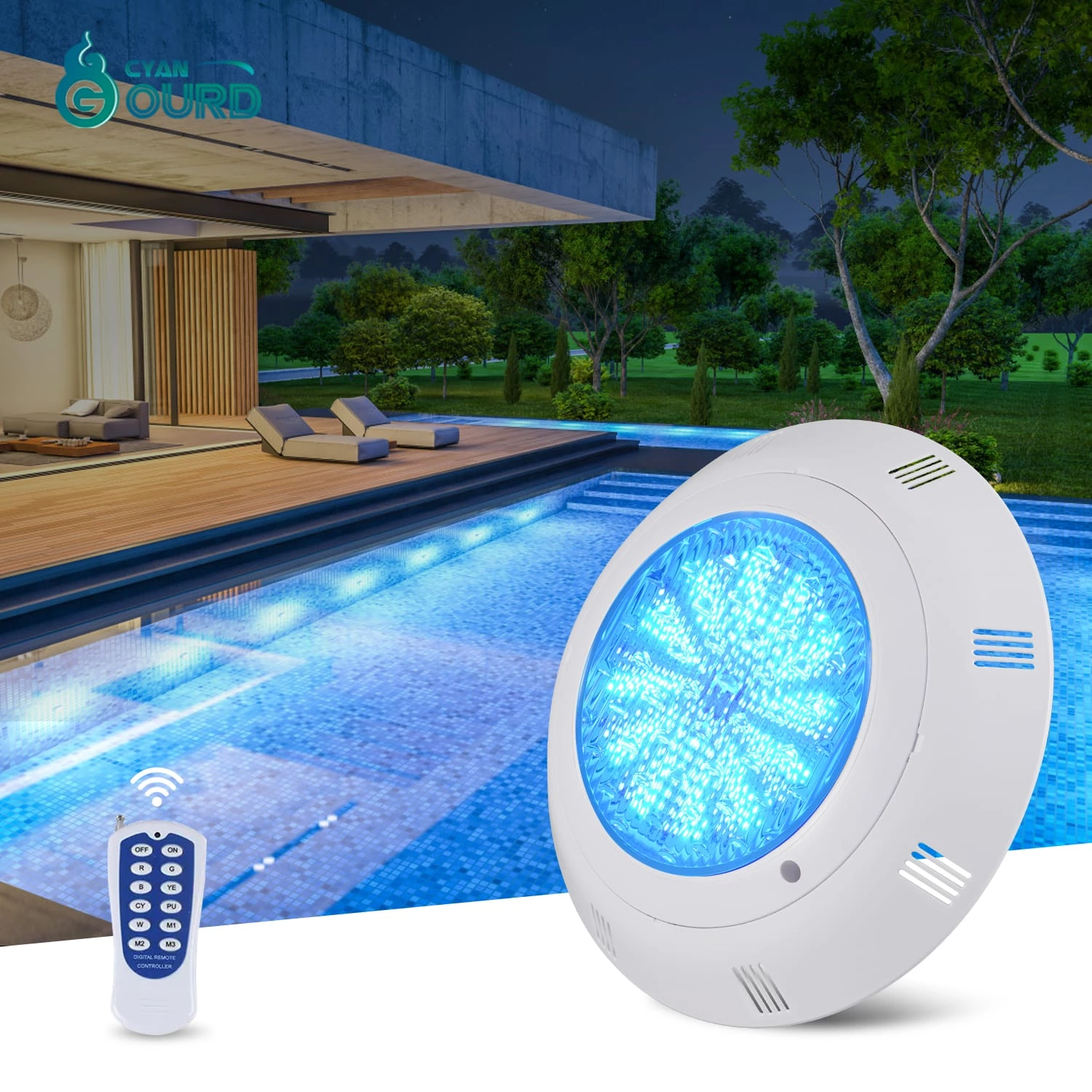
Commercial installations often face extreme conditions, including varying pH levels and high-velocity water movement that induces vibration. Unlike standard residential Led Pool Light units, commercial luminaires must endure consistent pressure. During our production process, we implement strict pressure-testing protocols, subjecting units to IP68 compliance testing at double the rated operational depth to ensure seal integrity. Failure to account for static pressure often results in moisture ingress, leading to driver oxidation and component failure.
Optics Selection: Why Narrow-Beam (5-15) is Essential for Vertical Waterfall Illumination
For long-throw applications, standard wide-angle residential LEDs suffer from rapid lux drop-off. Narrow-beam optics are critical for maintaining punch and focus across vertical water curtains. Our internal refraction physics analysis shows that a 5-degree beam maintains center-beam candlepower (CBCP) significantly better than a 15-degree beam over distances exceeding 3 meters. This precision is vital for the Led Waterfall Light range, where visibility through aerated, turbulent water is required.
Material Science: 316L Stainless Steel vs. ABS in Long-Term Installations
While Abs Pool Light housings are cost-effective for static pools, they may lack the impact resistance needed for high-flow fountain nozzles. We recommend 316L Stainless Steel Pool Light housing for its superior chemical resistance against chlorinated or recycled water. Testing in our lab demonstrates that 316L variants maintain structural integrity in high-salinity environments where lower-grade metals or plastics exhibit signs of pitting or embrittlement after 18 months.
Thermal Dissipation and Seal Integrity: Preventing Lens Fog
Heat is the primary enemy of LED longevity in underwater applications. Our YC series employs proprietary heat-sink geometry to pull heat away from the diode array. In our factory audits, we have observed that superior thermal management prevents lens fogging by maintaining internal temperature equilibrium. This is distinct from our Nicheless Pool Light QR-55, which uses an ABS chassis optimized for different installation profiles. Proper dissipation reduces the maintenance interval by preventing accelerated thermal degradation of the potting compound.
Summary Specification Matrix for Project Bidders
| Feature | Commercial Requirement |
|---|---|
| Housing Material | 316L Stainless Steel |
| IP Rating | IP68 (Tested to 2x depth) |
| Beam Angle | 5-15 Degrees (Precision) |
| Testing Standard | IEC 60598-2-18 Compliant |
FAQ: Technical Specifications and Maintenance
Q: Why is 316L stainless steel preferred over 304 in fountains?
A: 316L contains molybdenum, which significantly increases resistance to corrosion in high-chloride or low-pH water environments common in treated municipal fountains.
Q: Does a narrow beam angle consume more power?
A: No. Narrow beam angles focus the existing lumen output using optical lenses rather than increasing power draw, resulting in higher intensity at a distance.
Q: How do you verify IP68 compliance?
A: We perform internal hydrostatic testing where units are submerged at double the required depth for 24-72 hours to ensure zero water ingress.
Q: Can I use residential lights in a high-flow waterfall?
A: Residential-grade lights often lack the vibration dampening and pressure ratings of commercial fixtures, leading to premature seal failure in high-flow settings.
Q: What is the benefit of the QR-55 model design?
A: The QR-55 provides a compact nicheless profile suitable for specific architectural cavities where space is constrained, utilizing an ABS housing for rapid, non-corrosive installation.
Download Technical Spec Sheet | Request Project Consultation for Custom Photometry