Русский
 Français
 بالعربية
 Español
Types Of Swimming Pool Lights: A Manufacturer’s Perspective On Structure And Performance
Types Of Swimming Pool Lights: A Manufacturer’s Perspective On Structure And Performance
Selecting the correct underwater lighting solution requires a deep understanding of structural integrity, material composition, and optical performance. For distributors, engineers, and pool contractors, distinguishing between the various types of swimming pool lights is critical for ensuring long-term reliability and client satisfaction. As a dedicated manufacturer, Cyangourd Lighting categorizes LED pool lights not just by aesthetics, but by their engineering standards, installation methods, and waterproofing technologies. This guide analyzes the primary classifications of pool lights to aid in better procurement and project planning.
1. Classification by Installation Structure: Wall-Mounted vs. Recessed
The physical structure of the light housing dictates the installation process and the final look of the pool. The two dominant categories in the market are surface-mounted (wall-mounted) and recessed lights.
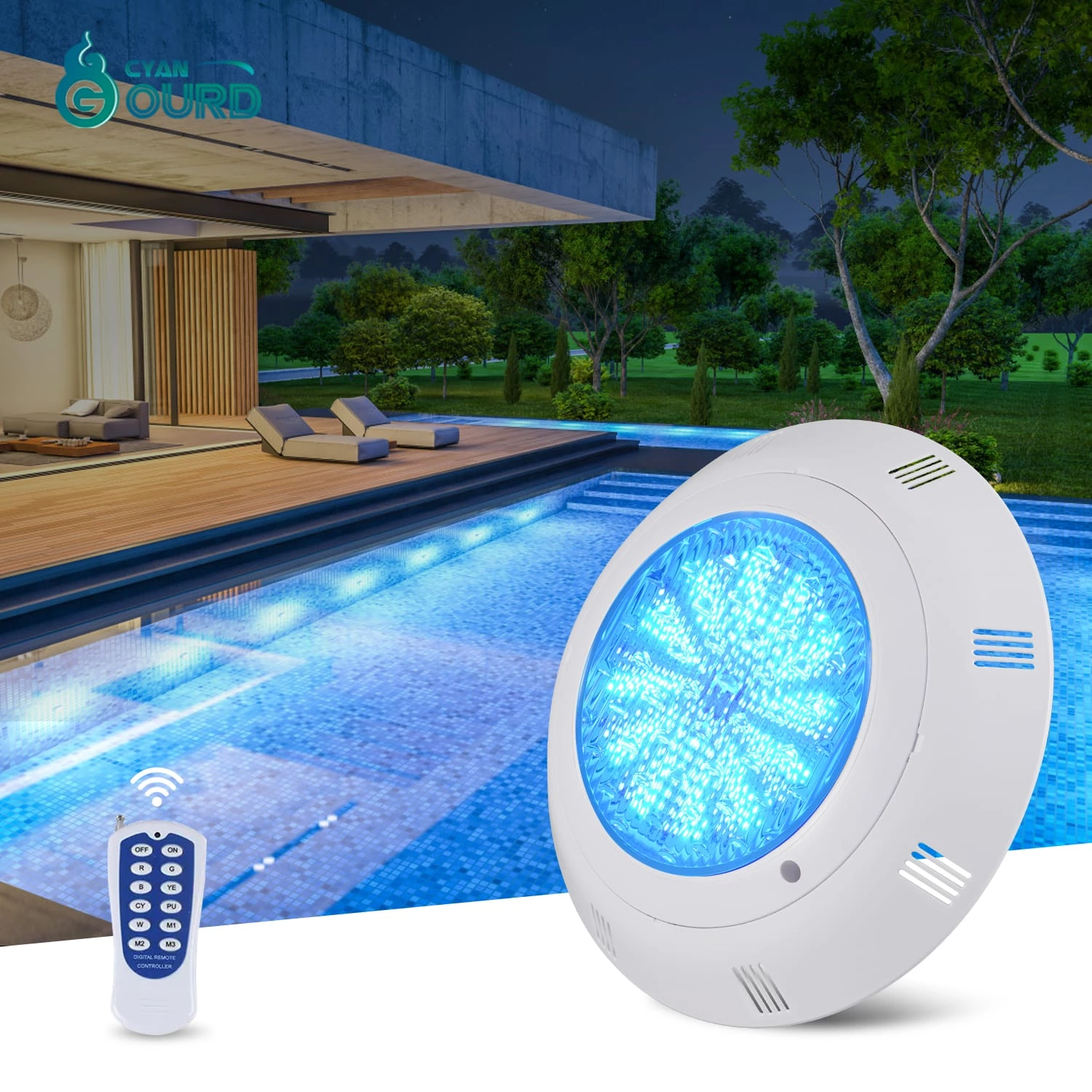
- Surface-Mounted (Wall-Mounted) Lights: These fixtures are installed directly onto the flat surface of the pool wall using a bracket. They are the preferred choice for renovation projects or existing pools where creating a niche is difficult. From a manufacturing perspective, these units must be slim (typically under 30mm) to minimize obstruction for swimmers.
- Recessed (Niche) Lights: Designed to fit inside a pre-installed bucket or niche within the concrete wall, these lights sit flush with the pool surface. This structure offers a streamlined aesthetic and is standard for new commercial construction. The PAR56 bulb is a sub-category here, often used to retrofit older halogen niches with modern LED technology.
2. Material Composition: Stainless Steel vs. Engineering Plastics
The durability of an underwater light is directly tied to its housing material. Manufacturers select materials based on thermal conductivity, corrosion resistance, and cost efficiency.
Stainless Steel (304/316L): High-end commercial projects demand 316L stainless steel due to its superior resistance to saltwater corrosion and harsh chemicals. It also provides excellent heat dissipation for high-wattage LEDs.
ABS + UV-Resistant PC: Engineering plastics offer a cost-effective alternative with high chemical resistance. While they have lower thermal conductivity than metal, advanced designs utilize internal heat sinks to manage LED temperatures effectively. These are widely used in residential vinyl and fiberglass pools.
3. Waterproofing Technologies: Resin-Filled vs. Gasket Sealed
Achieving an IP68 rating is the baseline, but the method used to achieve it defines the light's longevity.
Resin-Filled (Fully Potted): This is the modern manufacturing standard for maximum reliability. The internal LED board and components are completely encapsulated in a transparent epoxy resin. This eliminates air voids, preventing water ingress even if the outer lens cracks. It also improves thermal management by conducting heat away from the LEDs.
Gasket/O-Ring Sealed: Traditional lights rely on mechanical pressure and rubber gaskets to keep water out. While serviceable, these are more prone to failure over time as gaskets degrade or if the housing expands/contracts due to thermal cycling.
4. Optical Performance: SMD vs. COB LEDs
The type of LED chip used determines the beam angle, brightness, and energy efficiency of the fixture.
- SMD (Surface Mounted Device): The most common technology for pool lighting. SMD LEDs (e.g., SMD2835) offer a wide beam angle (typically 120 degrees), ensuring uniform illumination across the pool without creating hot spots. They are highly efficient and generate less heat per lumen.
- COB (Chip on Board): COB LEDs provide a high-intensity light source from a smaller area. They are often used for spot lighting or specific architectural features within a water feature, offering narrower beam angles but requiring more robust heat sinking.
5. Control Systems and Voltage Safety
Performance also encompasses how the lights are controlled and powered. Safety is paramount, with strict adherence to low-voltage standards (AC/DC 12V or 24V) to prevent electrical shock hazards.
For color-changing (RGB/RGBW) models, synchronization is a key performance metric. Manufacturers offer various control methods, including simple ON/OFF switching synchronization, external remote controls, and DMX512 systems for complex commercial light shows. Ensuring compatibility between the transformer, controller, and light fixture is essential for seamless operation.
Comparison of Pool Light Structures
| Structure Type | Installation Method | Waterproofing | Primary Application |
|---|---|---|---|
| Ultra-Thin Wall Mounted | Bracket on flat wall | Resin-Filled (Preferred) | Renovations, Vinyl/Fiberglass Pools |
| Recessed / Niche | Embedded in concrete | Gasket or Resin-Filled | New Concrete Construction, Luxury Pools |
| PAR56 Bulb | Fits existing housing | Glass/PC Body Sealed | Retrofitting Old Halogen Systems |
| Nozzle / Spout Light | Integrated into plumbing | Resin-Filled | Fountains, Spas, Water Features |
Frequently Asked Questions
1. Why do manufacturers recommend resin-filled lights over gasket-sealed ones?Resin-filled lights offer superior waterproofing because the internal components are completely encased in solid epoxy. This prevents water intrusion caused by thermal expansion or gasket degradation, significantly extending the lifespan of the fixture in underwater environments.
2. Which material type is best suited for saltwater swimming pools?For saltwater applications, 316L stainless steel is the gold standard due to its high resistance to chloride corrosion. Alternatively, high-quality ABS+PC plastic housings are also immune to rust and electrolysis, making them a viable cost-effective option.
3. Can recessed LED lights replace older halogen pool lights?Yes, specifically the PAR56 LED bulb type. These are designed to fit into standard legacy niches used for halogen lights. However, the transformer must be checked to ensure it outputs the correct voltage (usually 12V AC) compatible with the new LED unit.
4. What is the difference between 2-wire and 4-wire control for RGB lights?2-wire RGB lights typically use the power line for control (ON/OFF switching) or internal auto-cycling. 4-wire RGB lights require an external controller (V+, R, G, B) or DMX decoder, allowing for precise color selection and synchronization across multiple fixtures in commercial setups.
5. How does beam angle affect the choice of pool light type?A wide beam angle (120°) is standard for general pool illumination to ensure safety and visibility without dark spots. Narrow beam angles are reserved for specific architectural highlighting or fountain jets where focused light intensity is required.