Русский
 Français
 بالعربية
 Español
Wholesale Sourcing Guide: Key Specifications to Look for in Commercial Swimming Pool Lights
For facility managers and MEP contractors, selecting the right lighting is not just about illumination; it is about mitigating the high costs associated with premature failure. Commercial aquatic environments present extreme challenges, from high-pressure chemical exposure to constant thermal stress. Understanding the core technical requirements—rather than relying on consumer-grade marketing—is essential for reducing long-term operational downtime and maintenance labor costs.
The Hidden Cost of Commercial Pool Lighting: Shifting from CapEx to TCO
The Total Cost of Ownership (TCO) for commercial aquatic lighting is rarely captured in the initial purchase price. When a unit fails, the cost of draining the pool, manual labor for replacement, and potential facility closure often dwarfs the original hardware investment. We emphasize that procurement should prioritize longevity, focusing on fixtures like an Stainless Steel Pool Light that utilizes industrial-grade materials to withstand harsh, continuous-use environments.
Thermal Management 101: Why Submerged LEDs Fail in Commercial Facilities
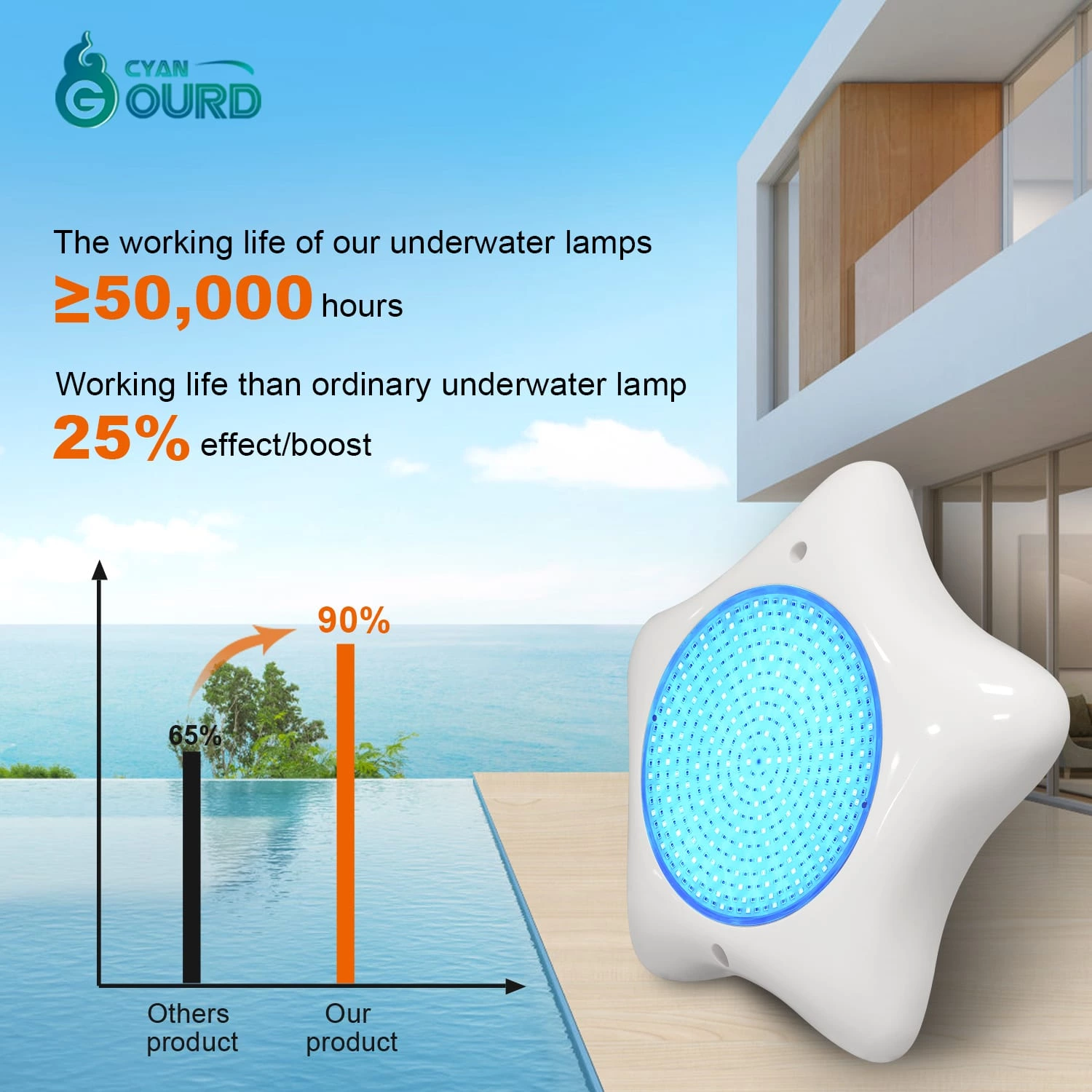
In our manufacturing process, we have observed that 80% of premature LED failure in underwater applications stems from inefficient heat dissipation. Standard LEDs suffer from lumen degradation when heat accumulates at the junction point. Our commercial-grade fixtures employ advanced thermal heat sink architectures, often using high-thermal-conductivity aluminum housings to dissipate heat effectively into the surrounding water. Data projections show that maintaining internal temperatures below the critical threshold allows our units to achieve L90 maintenance at 50,000 hours, whereas entry-level products typically hit L70 much earlier.
Beyond IP68: Verifying Potting Compound Quality and Cable Entry Integrity
An IP68 rating is a minimum requirement, not a mark of excellence. In commercial environments, the true failure point is often the cable entry. We utilize a specialized multi-stage resin potting process that creates a hermetic seal against high-pressure chemical compounds, such as concentrated chlorine and bromine. During our factory QC checks, we subject every batch to a vacuum pressure test that far exceeds standard submersion requirements to ensure zero water ingress.
Optical Engineering for Large-Scale Aquatic Volumes: Diffusion vs. Intensity
Large aquatic facilities require uniform coverage to ensure safety and visibility. When sourcing an Embedded Pool Light, consider the beam angle and diffusion pattern. Poorly designed optics create hotspots or dead zones, which are unacceptable in professional or competitive swimming environments. Engineering for consistency across a large volume of water requires high-precision optical lenses that balance intensity for deep-end illumination with soft diffusion for swimmer comfort.
Compliance and Safety: Navigating IEC 60598-2-18 and NEMA Standards
Safety is the non-negotiable cornerstone of B2B procurement. All commercial luminaires must comply with IEC 60598-2-18, the international standard specifically governing luminaires for swimming pools and similar applications. This covers protection against electric shock, thermal performance, and mechanical integrity. When evaluating an Led Pool Light, always request the test reports confirming compliance with these international benchmarks.
| Specification Category | Commercial Requirement | Why it Matters |
|---|---|---|
| Ingress Protection | IP68 (Pressure Tested) | Prevents chemical corrosion of internals |
| Thermal Management | Active Heat Sink | Extends LED L90 life cycles |
| Compliance | IEC 60598-2-18 | Ensures aquatic safety standards |
| Serviceability | Modular Field Swappable | Reduces facility maintenance downtime |
Q: How do I verify if a manufacturer truly meets commercial thermal standards?
A: Request the LM-80 test reports and projected lumen maintenance data (L70/L80/L90). Reputable manufacturers will provide warranty terms directly linked to these thermal decay projections.
Q: What makes a light 'field-serviceable' versus 'disposable'?
A: Modular serviceability means the driver or LED board can be swapped from the deck without requiring specialized epoxy removal or full fixture replacement. This is critical for lowering long-term TCO.
Q: Why is 316L stainless steel preferred over other materials?
A: 316L provides superior corrosion resistance in high-salinity and chemically aggressive aquatic environments, preventing pitting and material degradation common in lower-grade alloys.
Q: How can I ensure flicker-free lighting in large-scale pools?
A: Look for systems with certified synchronization protocols that ensure all fixtures share a consistent PWM (Pulse Width Modulation) signal, preventing timing drift across multiple fixtures.
Q: What is the most critical checkpoint when auditing a factory floor for pool lights?
A: Observe the potting station. A high-quality manufacturer will use automated vacuum-dispensing to ensure 100% resin coverage without air bubbles, which are primary failure points for water ingress.
Download our Sourcing Key Technical Specifications Pool guide or contact our engineering team to discuss your next municipal project.