Русский
 Français
 بالعربية
 Español
Efficiency Benefits of 12V LED Pool Lights vs Traditional Halogen PAR56
Efficiency Benefits of 12V LED Pool Lights vs Traditional Halogen PAR56
For decades, the 300W 12V PAR56 halogen bulb was the industry standard for swimming pool illumination. However, the shift toward LED technology has revolutionized the market, offering substantial efficiency gains for distributors, contractors, and facility managers. Transitioning from traditional halogen to 12V LED swimming pool lights is not merely a trend but a strategic upgrade that impacts energy consumption, maintenance cycles, and overall system longevity. As a dedicated manufacturer, we analyze the technical efficiency benefits that make LED the superior choice for modern aquatic environments.
Drastic Reduction in Energy Consumption
The most immediate efficiency benefit of 12V LED pool lights is the significant drop in wattage required to produce equivalent or superior brightness. A standard halogen PAR56 bulb typically consumes 300 watts. In contrast, a high-performance LED replacement usually operates between 18 and 35 watts. This represents an energy reduction of approximately 85% to 90%.
For commercial projects with multiple fixtures, such as hotel pools or municipal aquatic centers, this reduction lowers the total amperage load on the electrical infrastructure. This allows for the use of smaller transformers and reduces the operational overhead significantly over the lifespan of the installation.
Superior Luminous Efficacy and Directionality
Efficiency is not just about power input; it is about light output per watt. Halogen bulbs are omnidirectional and rely on reflectors to push light forward, resulting in significant lumen loss (often 30-40%) trapped inside the niche. They generate light by heating a filament, meaning the vast majority of energy is wasted as heat rather than visible light.
12V LED pool lights utilize directional diodes that project light outward into the water column with minimal waste. Modern SMD (Surface Mounted Device) LEDs offer high luminous efficacy, delivering bright, uniform illumination without the hot spots associated with halogen filaments. This optical efficiency ensures that a 35W LED can visually outperform a 300W halogen in underwater applications.
Thermal Management and Component Longevity
Heat is the enemy of underwater lighting electronics and seals. Halogen bulbs operate at extremely high temperatures, which can degrade rubber gaskets and O-rings over time, leading to water ingress and fixture failure. The excessive heat also promotes calcium buildup on the lens face.
LEDs, while they do generate heat, operate much cooler than incandescent filaments. High-quality LED pool lights employ advanced heat sinks or fully resin-filled structures to dissipate thermal energy effectively into the surrounding water. This thermal efficiency protects the internal driver components and preserves the integrity of the waterproofing seals (IP68 rating), resulting in a much longer service life.
Extended Lifespan and Reduced Maintenance Costs
Operational efficiency includes the frequency of replacement. A standard 12V halogen PAR56 bulb has a rated lifespan of approximately 2,000 to 3,000 hours. In a commercial setting where lights run nightly, this necessitates frequent replacements, incurring labor costs and downtime.
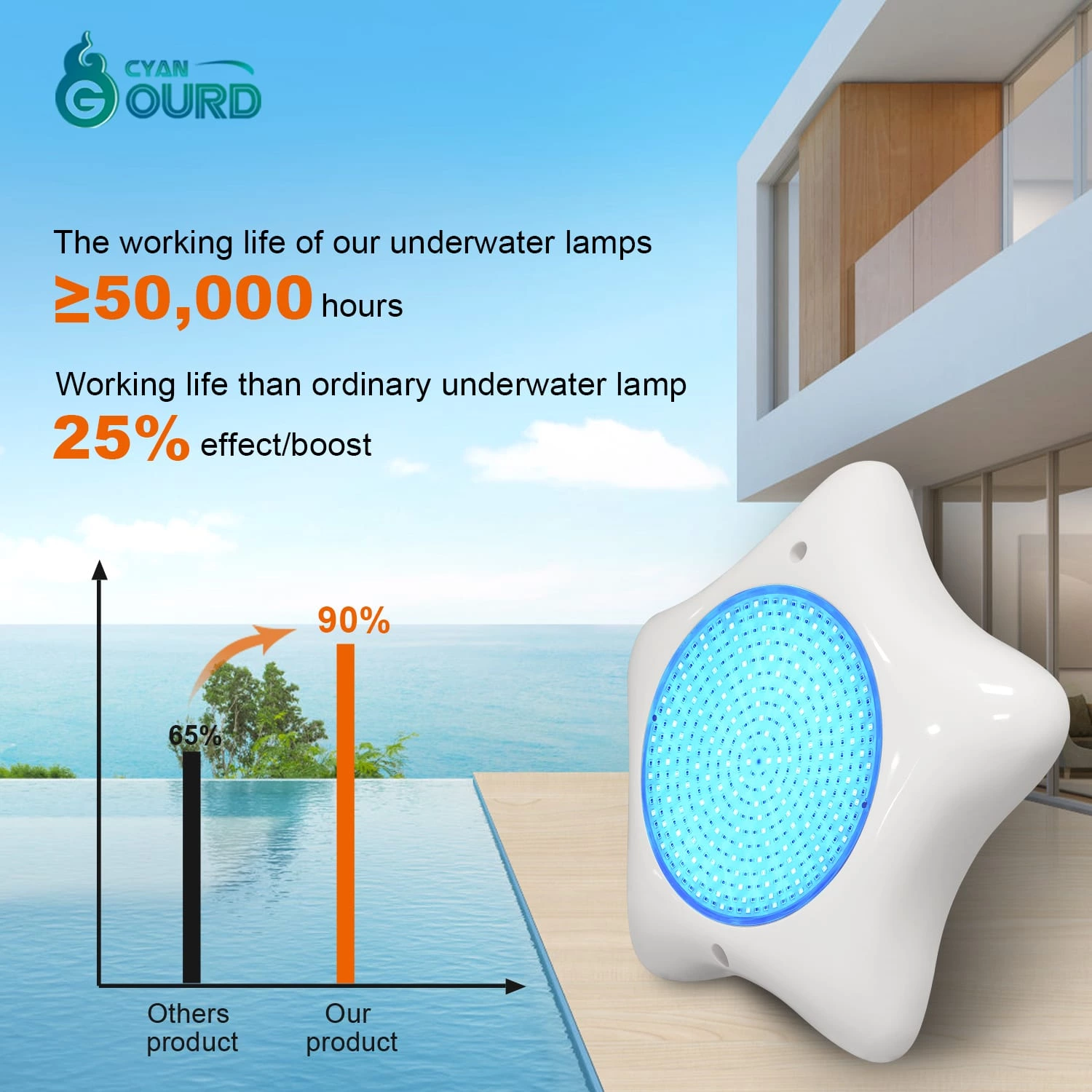
LED swimming pool lights are engineered for durability, with rated lifespans often exceeding 50,000 hours. For facility managers, this translates to years of maintenance-free operation. The use of durable materials like 316L stainless steel or UV-resistant ABS+PC further enhances the physical durability against pool chemicals, reducing the need for housing replacements.
Voltage Drop Mitigation
In low-voltage 12V systems, voltage drop over long cable runs is a critical concern. High-wattage halogen bulbs draw significant current (approx. 25 Amps for a 300W bulb), causing substantial voltage loss if cables are long or thin. This results in dim lights and potential overheating of wires.
Because 12V LED lights draw a fraction of the current (approx. 3 Amps for a 35W light), voltage drop is minimized. This efficiency allows installers to use existing cabling during retrofits without upgrading the wiring gauge, or to run longer cables in new installations without compromising light output stability.
Comparison: 300W Halogen vs. 35W LED PAR56
| Feature | Traditional Halogen PAR56 | 12V LED PAR56 |
|---|---|---|
| Power Consumption | 300 Watts | 18 - 35 Watts |
| Current Draw (at 12V) | ~25 Amps | ~1.5 - 3 Amps |
| Lifespan | 2,000 - 3,000 Hours | > 50,000 Hours |
| Heat Emission | Very High (Wasted Energy) | Low (Efficient Dissipation) |
| Color Options | Warm White Only (Filters required) | RGB, RGBW, Cool/Warm White |
Frequently Asked Questions
1. Can I use my existing 12V transformer when switching from halogen to LED?Yes, in most cases, existing AC 12V magnetic transformers used for halogen lights are compatible with LED replacements. However, because LEDs draw significantly less power, ensure the transformer is not under-loaded if it has a minimum wattage requirement. For optimal performance, specifically for RGB synchronization, a DC power supply or a compatible AC transformer is recommended.
2. How much money can be saved by switching to 12V LED pool lights?Savings are twofold: energy and maintenance. Energy costs can drop by up to 90%. Additionally, eliminating the labor and hardware costs of replacing halogen bulbs every season results in a rapid Return on Investment (ROI), typically within 12 to 18 months for commercial facilities.
3. Are 12V LED lights as bright as 300W halogen bulbs?Yes. A high-quality 35W LED PAR56 light can produce equivalent or higher lux levels than a 300W halogen. This is due to the directional nature of LEDs and higher luminous efficacy, which directs light into the pool rather than trapping it behind the bulb.
4. Do LED pool lights require special waterproofing compared to halogens?LED lights often feature superior waterproofing technologies, such as resin-filled bodies, which offer IP68 protection even if the outer lens cracks. Traditional halogen fixtures rely heavily on the niche gasket, which is prone to failure due to heat cycles. Resin-filled LEDs eliminate this vulnerability.
5. What is the benefit of resin-filled LED lights for efficiency?Resin-filling not only ensures 100% waterproofing but also acts as a thermal conductor. It pulls heat away from the LED chips and driver, transferring it to the water. This efficient thermal management prevents overheating, ensuring the light maintains peak brightness and efficiency throughout its lifespan.