Русский
 Français
 بالعربية
 Español
How do external drivers facilitate wireless synchronization for multiple ultra-thin pool lights in a single circuit?
How do external drivers facilitate wireless synchronization for multiple ultra-thin pool lights in a single circuit?
In the realm of architectural pool lighting, achieving perfect color synchronization across multiple fixtures is a critical requirement for commercial and high-end residential projects. For ultra-thin LED pool lights, which are often fully resin-filled and compact (typically under 10mm thick), internal space for complex control modules is non-existent. Consequently, external drivers serve as the central nervous system, facilitating wireless synchronization for multiple lights installed on a single circuit. By centralizing the control logic outside the water, manufacturers ensure reliability, ease of maintenance, and seamless color transitions.
The Architecture of External Driver Systems
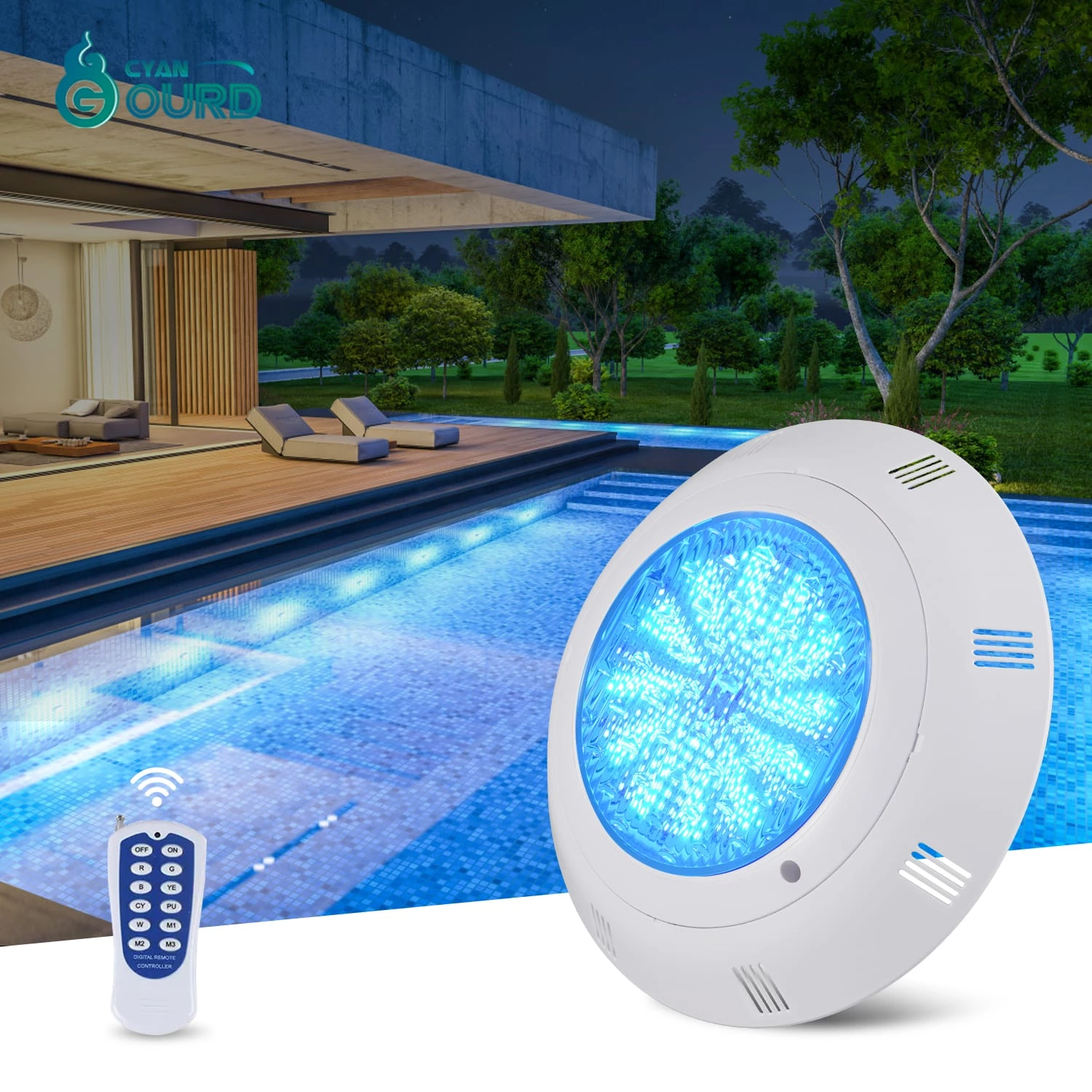
An external driver system separates the power supply and control logic from the underwater fixture. In this configuration, the "wireless" aspect refers to the communication between the user interface (remote control, smartphone app, or wall switch) and the external driver box, which is located in a dry, accessible equipment room. The driver receives the wireless command via RF (Radio Frequency), WiFi, or Bluetooth.
Once the command is received, the driver processes the signal and modulates the electrical output sent to the lights. Since all ultra-thin pool lights on the single circuit are wired in parallel to this central driver, they receive the exact same modulated power signal simultaneously. This architecture eliminates the need for individual lights to communicate with each other, guaranteeing absolute synchronization without signal lag.
Overcoming Signal Attenuation in Water
One of the primary engineering challenges in pool lighting is that water is an effective blocker of high-frequency radio signals. Attempting to send wireless signals directly to submerged lights often results in inconsistent performance or complete signal loss. External drivers solve this by keeping the receiver antenna in the air, not the water.
By placing the control unit above ground, the system bypasses the physical limitations of underwater RF transmission. The driver converts the wireless instruction into a wired protocol—typically PWM (Pulse Width Modulation) or a specific PLC (Power Line Communication) signal—which travels through the copper cabling to the ultra-thin fixtures. This ensures that the IP68 resin-filled lights respond instantly to color changes, regardless of pool depth or water conditions.
Wiring Topologies for Single Circuit Synchronization
To facilitate synchronization on a single circuit, proper wiring topology is essential. Ultra-thin pool lights are generally low-voltage (AC/DC 12V or 24V) to ensure safety. In a single circuit setup, multiple lights are connected in parallel to the output terminals of the external driver. The driver manages the color channels (Red, Green, Blue, and optionally White) by adjusting the voltage on specific wires.
For example, in a 4-wire RGB system, the external driver might ground the Red channel wire to illuminate red LEDs across all connected fixtures. Because the lights are "dumb" terminals that simply react to the power state provided by the "smart" driver, it is physically impossible for one light to be out of sync with another on the same circuit, provided the voltage drop is managed correctly through adequate cable gauging.
Advantages of Centralized Control for Maintenance
For B2B buyers and facility managers, the external driver approach offers significant maintenance advantages. If a synchronization issue occurs or a control module fails, the technician does not need to drain the pool or remove underwater fixtures. The troubleshooting takes place at the external driver panel.
Furthermore, this setup allows for higher wattage capacities. A single robust external driver can manage a large array of ultra-thin lights—often 10 to 20 units depending on wattage—simplifying the electrical infrastructure. This centralization reduces the number of potential failure points compared to systems where every light contains its own complex receiver and transformer.
Comparison: External Driver vs. Internal Controller
When selecting ultra-thin pool lights for wholesale distribution or large projects, understanding the difference between external and internal control architectures is vital. The table below outlines why external drivers are preferred for synchronized applications.
| Feature | External Driver System | Internal Controller (Inside Light) |
|---|---|---|
| Signal Reception | Excellent (Receiver in air) | Poor (Signal blocked by water) |
| Synchronization | Perfect (Shared power source) | Prone to drift over time |
| Maintenance | Easy (Dry land access) | Difficult (Requires removing light) |
| Heat Management | High (Separate unit) | Limited (Confined in resin) |
| Scalability | High (Single circuit for many lights) | Low (Individual pairing often required) |
Frequently Asked Questions
1. How many ultra-thin pool lights can be synchronized on a single external driver?
The number of lights depends on the total wattage capacity of the external driver and the power consumption of each fixture. Generally, the total wattage of the lights should not exceed 80% of the driver's rated capacity to ensure longevity and safety. For example, a 300W driver can safely sync roughly ten 24W lights.
2. Can I use a WiFi controller with an external driver for smartphone control?
Yes, many external drivers are compatible with WiFi or Bluetooth modules. The WiFi module connects to the driver input, allowing users to send signals via a smartphone app. The driver then translates these digital commands into the voltage changes required to sync the underwater lights.
3. Does the distance between the driver and the lights affect synchronization?
Synchronization remains consistent regardless of distance, but voltage drop can affect brightness. If the cable run is too long without sufficient gauge thickness, lights furthest from the driver may appear dimmer or have slight color shifts (e.g., white looking yellowish). Proper electrical planning is required to maintain uniform output.
4. Are external drivers compatible with both RGB and RGBW ultra-thin lights?
Yes, but the driver must match the light type. An RGB light requires a 4-wire driver (Common + R, G, B), while an RGBW light requires a 5-wire driver to control the dedicated white channel. Using a mismatched driver will result in the inability to control specific colors or the white spectrum.
5. What happens if the external driver fails?
If the external driver fails, all lights on that circuit will typically turn off or stop changing colors. The advantage of this system is that the lights themselves are likely still functional. You simply replace the driver unit in the equipment room without needing to access the pool or touch the underwater fixtures.