Русский
 Français
 بالعربية
 Español
Lifespan Expectations: Constant Current vs. Constant Voltage Submersible LED Pool Lights
Lifespan Expectations: Constant Current vs. Constant Voltage Submersible LED Pool Lights
In the manufacturing and distribution of submersible LED lighting, the choice between Constant Current (CC) and Constant Voltage (CV) driver technologies is a determining factor in product longevity. For B2B buyers and pool contractors, understanding the technical implications of these power methods is essential for selecting fixtures that minimize maintenance costs and warranty claims. While both systems operate on low-voltage safety standards (typically AC/DC 12V or 24V), their impact on the lifespan of the LED chips and internal components differs significantly, particularly within the sealed, resin-filled structure of an IP68 pool light.
The Role of Driver Topology in LED Longevity
The lifespan of an LED pool light is rarely dictated by the LED chip itself, which can theoretically last over 100,000 hours. Instead, the failure point is often the driver circuitry or thermal stress. Driver topology controls how electricity is delivered to the diodes. In a submersible environment where heat dissipation is managed through the housing (often 316L stainless steel) and water cooling, the efficiency of this electrical delivery directly correlates to the operating temperature and, consequently, the lifespan of the fixture.
Constant Voltage (CV) Limitations in Submersible Environments
Constant Voltage LED lights rely on resistors to limit the current flowing through the LED strings. While this design is cost-effective for manufacturing, it introduces inefficiencies. Resistors dissipate excess energy as heat, adding to the thermal load inside the resin-filled housing. Furthermore, if the input voltage fluctuates—common in large commercial pool installations with long cable runs—the current flowing through the LEDs can spike. These fluctuations accelerate lumen degradation and can lead to premature failure, typically limiting CV pool lights to a lifespan of 20,000 to 30,000 hours.
Why Constant Current (CC) Maximizes Operational Lifespan
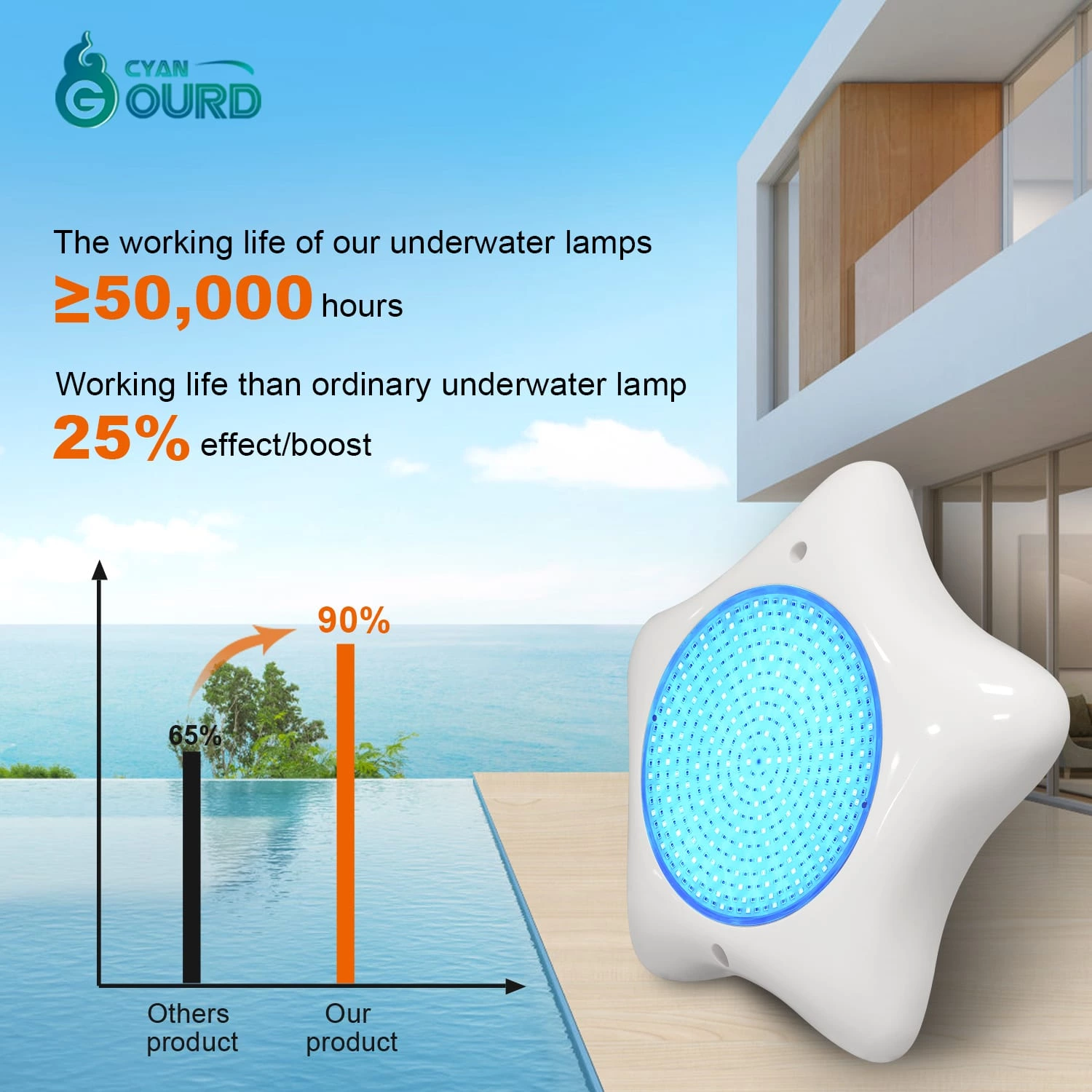
Constant Current drivers represent the industrial standard for high-quality submersible lighting. A CC driver actively monitors and adjusts the voltage to ensure a fixed current flows to the LEDs, regardless of minor input voltage fluctuations. This precise control eliminates the need for current-limiting resistors, significantly reducing internal heat generation. By maintaining the LEDs within their optimal operating parameters, Constant Current pool lights routinely achieve lifespans exceeding 50,000 hours. For wholesale distributors, this translates to higher customer satisfaction and fewer returns.
Thermal Management and Component Stress
Heat is the primary enemy of LED electronics. In IP68 waterproof lights, components are encapsulated in resin or silicone to prevent water ingress. This sealing makes thermal management challenging. Constant Current systems generate less waste heat compared to Constant Voltage systems. Lower internal temperatures preserve the integrity of the PCB, the soldering points, and the encapsulating resin itself, preventing expansion/contraction cycles that could compromise the waterproof seal over time.
Voltage Drop and Its Effect on Component Stress
In commercial swimming pools, lights are often located far from the power source, leading to voltage drop along the cables. In a Constant Voltage system, a drop in voltage results in dimmer lights, while a surge can overdrive them. Constant Current drivers are designed to compensate for voltage drop (within a specific range) without altering the brightness or stressing the LED chips. This stability ensures that lights at the end of a long circuit last just as long as those closest to the transformer.
| Comparison Metric | Constant Voltage (CV) | Constant Current (CC) |
|---|---|---|
| Expected Lifespan | 20,000 – 30,000 Hours | 50,000+ Hours |
| Heat Generation | High (due to resistors) | Low (efficient driver control) |
| Voltage Drop Sensitivity | High (brightness fluctuates) | Low (auto-compensation) |
| Lumen Maintenance | Degrades faster due to stress | Consistent over time |
| Ideal Application | Budget residential projects | Commercial & high-end pools |
Frequently Asked Questions
- 1. Why does Constant Current technology cost more than Constant Voltage?
Constant Current lights utilize more complex integrated circuits (ICs) within the driver to actively manage power delivery, whereas Constant Voltage lights use simple, inexpensive resistors. The higher initial cost of CC is offset by the significantly longer lifespan and reduced maintenance.
- 2. Can I use a standard 12V transformer for Constant Current pool lights?
Yes, most Constant Current LED pool lights are designed to accept a standard AC/DC 12V or 24V input. The internal driver converts this input into the precise current required by the LEDs, making them compatible with standard magnetic or electronic transformers.
- 3. How does heat affect the IP68 rating of the light over time?
Excessive heat causes materials to expand and contract. In a resin-filled IP68 light, constant thermal cycling can eventually cause the resin to separate from the housing, creating gaps for water ingress. Constant Current drivers generate less heat, minimizing this risk.
- 4. Are Constant Current lights better for projects with long cable runs?
Absolutely. Long cables cause voltage drop. A Constant Current driver can tolerate a wider range of input voltage (e.g., 10V-18V) while keeping the LED output steady, ensuring uniform brightness across the entire pool regardless of cable length.
- 5. What is the typical warranty difference between CC and CV pool lights?
Due to the superior durability and thermal management of Constant Current systems, manufacturers typically offer longer warranties (often 2-3 years or more) compared to the standard 1-year warranty often found with Constant Voltage fixtures.