Русский
 Français
 بالعربية
 Español
Pool Light Fixture Replacement in Commercial Renovation Projects: Compatibility Challenges Manufacturers Address
Pool Light Fixture Replacement in Commercial Renovation Projects: Compatibility Challenges Manufacturers Address
Commercial pool renovation projects present a unique set of complexities compared to new construction. When upgrading aquatic centers, hotel pools, or resort facilities, contractors often encounter outdated infrastructure that does not align with modern LED technology standards. As a dedicated manufacturer of LED swimming pool lights, Cyangourd Lighting addresses these compatibility challenges through engineering precision and versatile product design. This guide explores the critical technical hurdles in fixture replacement and how manufacturing innovations bridge the gap between legacy systems and modern efficiency.
1. Navigating Niche Dimensions and Housing Constraints
One of the most significant obstacles in commercial retrofitting is the physical incompatibility between modern LED fixtures and existing wet niches. Many commercial pools built decades ago utilize halogen fixtures with proprietary dimensions or obsolete PAR56 housings that are no longer standard. Removing embedded niches from concrete shells is costly and risks compromising the pool's structural integrity.
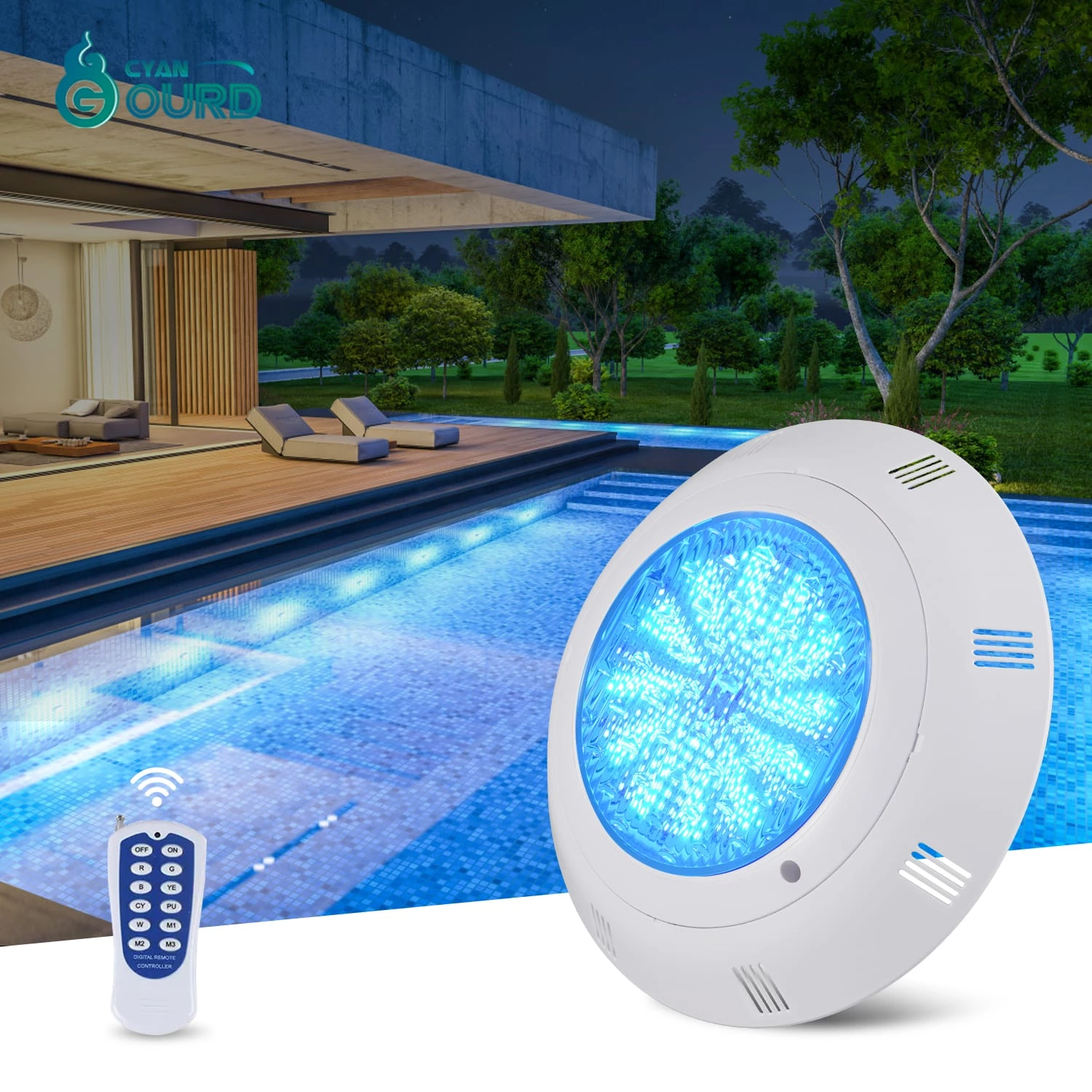
To address this, manufacturers engineer ultra-thin, surface-mounted LED lights and universal retrofit kits. These solutions are designed to fit inside existing niches using adjustable mounting brackets or adapter rings. For example, a resin-filled flat light can be mounted over a standard 6-inch niche, utilizing the existing conduit entry without requiring demolition. This adaptability ensures that the transition to LED does not require extensive civil engineering work.
2. Voltage Mismatches and Transformer Load Management
Legacy commercial pools often operate on high-voltage systems (120V or 220V) directly to the fixture, a practice now deemed less safe compared to modern low-voltage standards. Contemporary LED pool lights predominantly operate on 12V or 24V AC/DC to ensure swimmer safety and compliance with international codes like NEC or IEC.
During renovation, simply swapping the fixture is insufficient. The entire power delivery system must be assessed. Manufacturers provide wide-voltage compatible drivers and recommend specific step-down transformers. Furthermore, because LEDs consume significantly less power than halogens (e.g., replacing a 300W halogen with a 35W LED), the existing wiring gauge is usually sufficient, but the transformer load must be recalculated to prevent under-loading or voltage drop issues over long cable runs common in large commercial facilities.
3. Integrating Modern Control Systems with Legacy Wiring
Commercial clients often demand dynamic RGB or RGBW lighting effects, which require sophisticated control signals. However, older pools typically have simple 2-wire power cables buried in concrete, making it impossible to run new data cables for DMX512 or 4-wire control systems without major excavation.
Manufacturers solve this by developing Power Line Communication (PLC) technology or advanced remote control synchronization that operates over the existing 2-wire AC power line. This allows facility managers to achieve synchronized color changing and dimming across multiple fixtures using the original wiring infrastructure. For projects where DMX is mandatory, wireless DMX bridges or specific 2-wire DMX decoding drivers are engineered to bypass the need for physical data cabling.
4. Material Compatibility in Harsh Commercial Environments
Commercial pools, particularly those using saltwater chlorination systems or heated therapy pools, create highly corrosive environments. An older plastic niche might be intact, but the new fixture must withstand aggressive chemical exposure. Standard 304 stainless steel may succumb to pitting corrosion in saltwater applications.
To ensure longevity in renovations, manufacturers utilize 316L stainless steel or fully resin-filled polycarbonate (PC) bodies. These materials offer superior resistance to chloride attack and galvanic corrosion. Additionally, the thermal management of the fixture is critical; since LEDs are heat-sensitive, the fixture design must account for the potentially higher ambient water temperatures found in commercial spas or hydrotherapy pools.
5. Ensuring IP68 Integrity During Retrofit Installation
The most common failure point in retrofitting is the cable connection. In new construction, the cable is run continuously to the junction box. In renovations, contractors might be tempted to splice cables underwater if the old conduit is blocked, which is a major failure risk. Even when pulling new cable, the seal at the niche entry is critical.
Manufacturers address this by providing fixtures with varying cable lengths (e.g., 20m, 30m) to reach the deck box without splicing. Furthermore, modern LED lights often feature fully resin-filled internals. Unlike traditional gasket-sealed lights where a compromised O-ring leads to failure, a resin-filled light remains waterproof even if the outer casing is cracked. This design offers a higher safety margin for commercial projects where maintenance downtime is costly.
Comparison of Retrofit Lighting Solutions
Selecting the right retrofit approach depends on the existing infrastructure. The table below compares common manufacturing solutions for commercial upgrades.
| Retrofit Solution Type | Best Application | Installation Complexity | Key Advantage |
|---|---|---|---|
| PAR56 LED Bulb Replacement | Standard Euro/US niches with intact housings | Low (Plug & Play) | Cost-effective; utilizes existing niche and faceplate. |
| Ultra-Thin Surface Mount | Damaged niches or non-standard dimensions | Medium (Requires bracket mounting) | Bypasses niche size constraints; modern aesthetic. |
| Universal Adapter Kits | Specific brand replacements (e.g., Pentair/Hayward retrofits) | Medium | Ensures secure fit in proprietary niche shapes. |
| Resin-Filled Panel Lights | High-traffic commercial pools requiring durability | Low to Medium | 100% Waterproof (IP68); zero condensation risk. |
Frequently Asked Questions
1. Can we use existing 2-wire cabling for RGB color-changing lights in a renovation?
Yes, manufacturers offer On/Off switch control or Power Line Communication (PLC) systems that transmit data over standard 2-wire power cables. This allows for synchronized color changing without the need to install new 4-wire or 5-wire data cables, significantly reducing renovation costs.
2. How do we handle voltage differences when replacing 120V halogen lights?
You must install a step-down transformer to convert the mains voltage (120V/220V) to the safe low voltage (12V/24V) required by LED fixtures. The transformer should be located in a dry, accessible area, and the existing high-voltage wiring to the niche must be disconnected and replaced or repurposed for low-voltage transmission if code permits.
3. What is the best material for saltwater commercial pool lights?
For saltwater environments, 316L stainless steel is the preferred metal due to its molybdenum content, which resists chloride corrosion. Alternatively, high-grade ABS+PC plastics or fully resin-filled fixtures offer excellent chemical resistance and eliminate the risk of metal oxidation entirely.
4. Do LED retrofit lights require a specific niche size?
While PAR56 bulbs fit standard PAR56 niches, many modern surface-mounted LED lights are designed to be "niche-less" or universal. They can be mounted over existing niches of various sizes (6-inch to 10-inch) using cross-brackets, making them compatible with a wide range of legacy infrastructure.
5. How does resin-filled technology improve commercial pool light longevity?
Resin-filled technology involves filling the internal cavity of the light with a specialized epoxy. This eliminates air gaps, preventing condensation and water ingress even if the outer lens is damaged. This design achieves a superior IP68 rating and is ideal for commercial pools where lights are subjected to constant pressure and chemical exposure.