Русский
 Français
 بالعربية
 Español
Pool Light Replacement Guide for Commercial and Hospitality Projects
Pool Light Replacement Guide for Commercial and Hospitality Projects
For hospitality managers, resort operators, and commercial contractors, maintaining pristine aquatic facilities is crucial for guest satisfaction. Lighting plays a pivotal role in the ambiance and safety of commercial pools. However, aging lighting infrastructure often leads to frequent maintenance, high energy costs, and safety concerns. This guide outlines the strategic approach to replacing pool lights in commercial and hospitality environments, focusing on durability, safety compliance, and efficient retrofitting with modern LED technology.
Assessing Existing Infrastructure for Retrofit Compatibility
Before procuring replacement lights, a thorough audit of the existing installation is required. Commercial pools often utilize legacy halogen systems or early-generation LEDs that may not meet current efficiency standards. The first step is identifying the niche type and housing dimensions. Many commercial projects require PAR56 bulbs or surface-mounted lights that fit specific industry-standard niches.
It is essential to verify the cabling condition and the transformer capacity. Upgrading to LED usually reduces the electrical load, allowing existing transformers to be retained, provided they output the correct voltage (typically AC 12V). However, ensuring the existing niches are watertight and free from corrosion is critical before installing new fixtures.
Selecting Materials for High-Traffic Aquatic Environments
Hospitality pools are subjected to heavy usage and higher concentrations of sanitizing chemicals compared to residential pools. Therefore, material selection is paramount for longevity. For commercial replacements, we recommend fixtures constructed from 316L stainless steel or high-grade UV-resistant ABS+PC materials. These materials offer superior resistance to chlorine and saltwater corrosion.
Furthermore, the internal structure of the light must guarantee waterproofing. Fully resin-filled LED lights provide the highest level of protection (IP68 rating) by eliminating internal air voids where condensation could form. This technology ensures that even if the outer lens is compromised, the internal components remain sealed against water ingress, significantly reducing maintenance intervals for hotel engineering teams.
Comparison: Legacy Halogen vs. Modern LED Retrofits
When planning a capital expenditure for pool lighting upgrades, understanding the return on investment and operational differences is vital. The table below compares traditional halogen systems with modern resin-filled LED replacements.
| Feature | Legacy Halogen Lights | Resin-Filled LED Retrofits |
|---|---|---|
| Energy Consumption | High (300W - 500W per fixture) | Low (18W - 54W per fixture) |
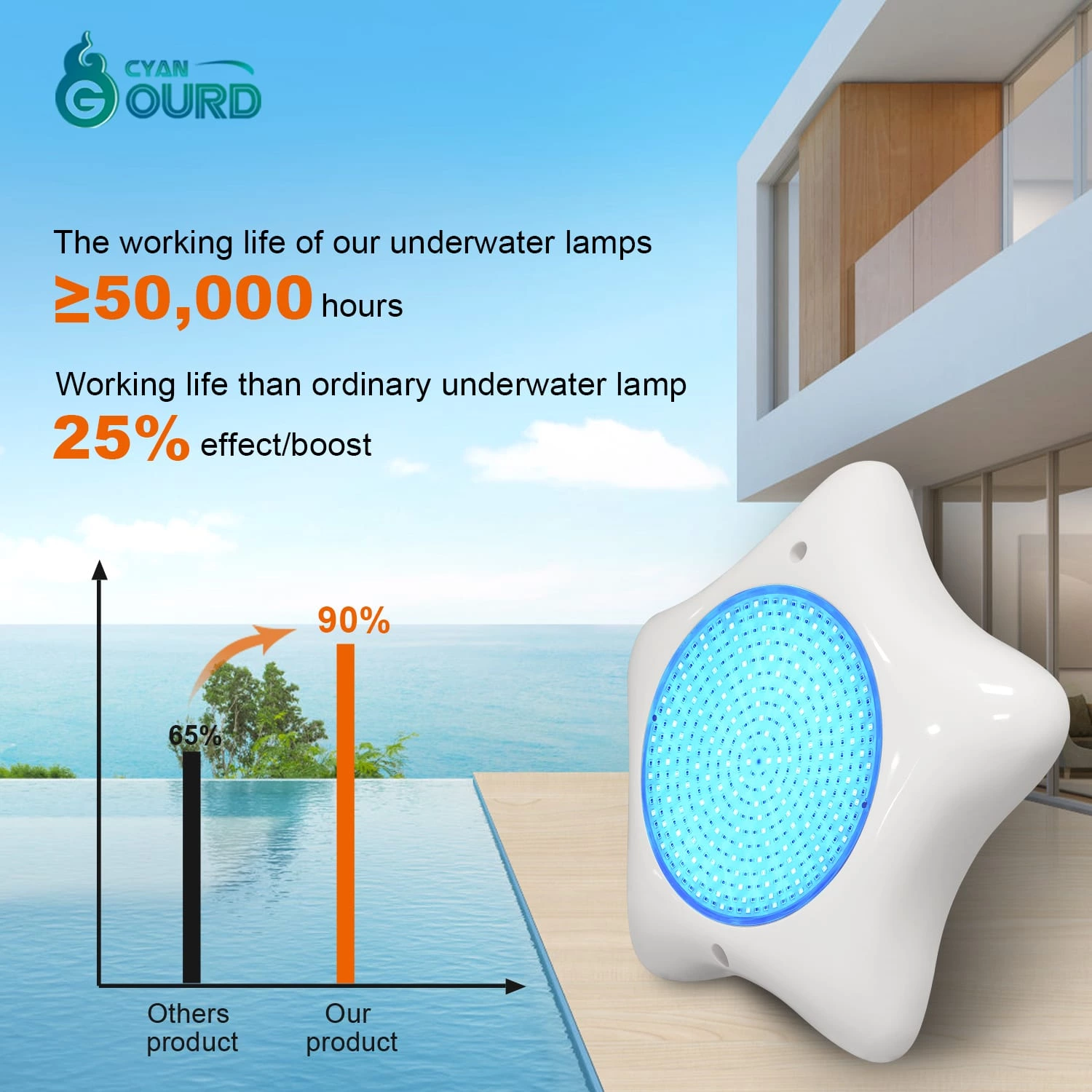
| Lifespan | 2,000 - 4,000 hours | 50,000+ hours |
| Waterproof Reliability | Relies on O-ring gaskets (prone to failure) | IP68 Resin-filled (Solid state sealing) |
| Maintenance Frequency | Frequent bulb changes required | Minimal to zero maintenance |
| Heat Emission | High heat output | Cool operation, safe for touch |
Voltage Safety and Transformer Management
Safety is the non-negotiable priority in commercial pool environments. Replacement lights must operate on low voltage, typically AC/DC 12V or 24V, to eliminate the risk of electric shock. When replacing older lights, facility managers must verify that the existing transformers are compatible with LED loads.
While LEDs consume less power, they are sensitive to voltage drops over long cable runs, which are common in large resort pools. It is crucial to calculate the wire gauge and distance to ensure the fixture receives the correct voltage. Using toroidal transformers or switching power supplies designed for LED lighting ensures stable performance and prevents flickering.
Minimizing Facility Downtime During Installation
For hotels and resorts, closing a pool for maintenance results in lost revenue and guest dissatisfaction. Choosing the right replacement product can significantly reduce downtime. Surface-mounted LED lights or universal retrofit kits allow for installation without extensive structural work or draining the entire pool, provided there is enough cable slack in the niche.
Contractors should opt for lights that utilize standard mounting brackets or PAR56 bulbs that fit directly into existing housings. This "plug-and-play" approach allows for rapid changeovers, often enabling maintenance teams to complete the upgrade within a few hours rather than days.
Advanced Control and Synchronization
Modernizing a commercial pool is not just about illumination; it is about experience. Large commercial pools often require multiple lights to be synchronized perfectly. When sourcing replacements, ensure the LED drivers support synchronization protocols such as DMX512 or proprietary PLC (Power Line Communication) systems.
This capability allows facility managers to control color changes, brightness, and scheduling centrally. For high-end hospitality projects, integrating pool lighting with the broader building management system creates a cohesive aesthetic across the property.
Frequently Asked Questions
-
1. Do we need to drain the commercial pool to replace the lights?
Not necessarily. If the original installation left sufficient cable slack coiled in the niche, the fixture can be pulled up to the pool deck for replacement. However, if the cable is too short or the niche is damaged, partial draining may be required.
-
2. Can we use our existing 12V transformers for new LED lights?
In most cases, yes. Since LEDs consume significantly less power than halogens, the existing transformer capacity is usually sufficient. However, you must ensure the transformer outputs AC 12V if the new lights are AC-compatible, or install a rectifier if DC is required.
-
3. What is the advantage of resin-filled lights for hotel pools?
Resin-filled lights offer the highest IP68 waterproof rating. By filling the internal cavity with epoxy resin, the risk of water ingress due to thermal expansion and contraction is eliminated, making them far more durable for commercial applications than air-filled housings.
-
4. How do we ensure color synchronization across multiple lights?
You must purchase lights that share the same control protocol (e.g., switch control, remote, or DMX). For large commercial pools, using a centralized control box or DMX decoder ensures all lights change colors and modes simultaneously without drift.
-
5. What certifications should we look for in commercial pool lights?
For commercial projects, look for CE, RoHS, and IP68 certifications as a baseline. Depending on the region, ETL or UL listing may also be required to meet local electrical codes for public swimming facilities.