Русский
 Français
 بالعربية
 Español
LED Pool Light Lifespan Explained: What Determines 25,000 vs 50,000 Hours?
LED Pool Light Lifespan Explained: What Determines 25,000 vs 50,000 Hours?
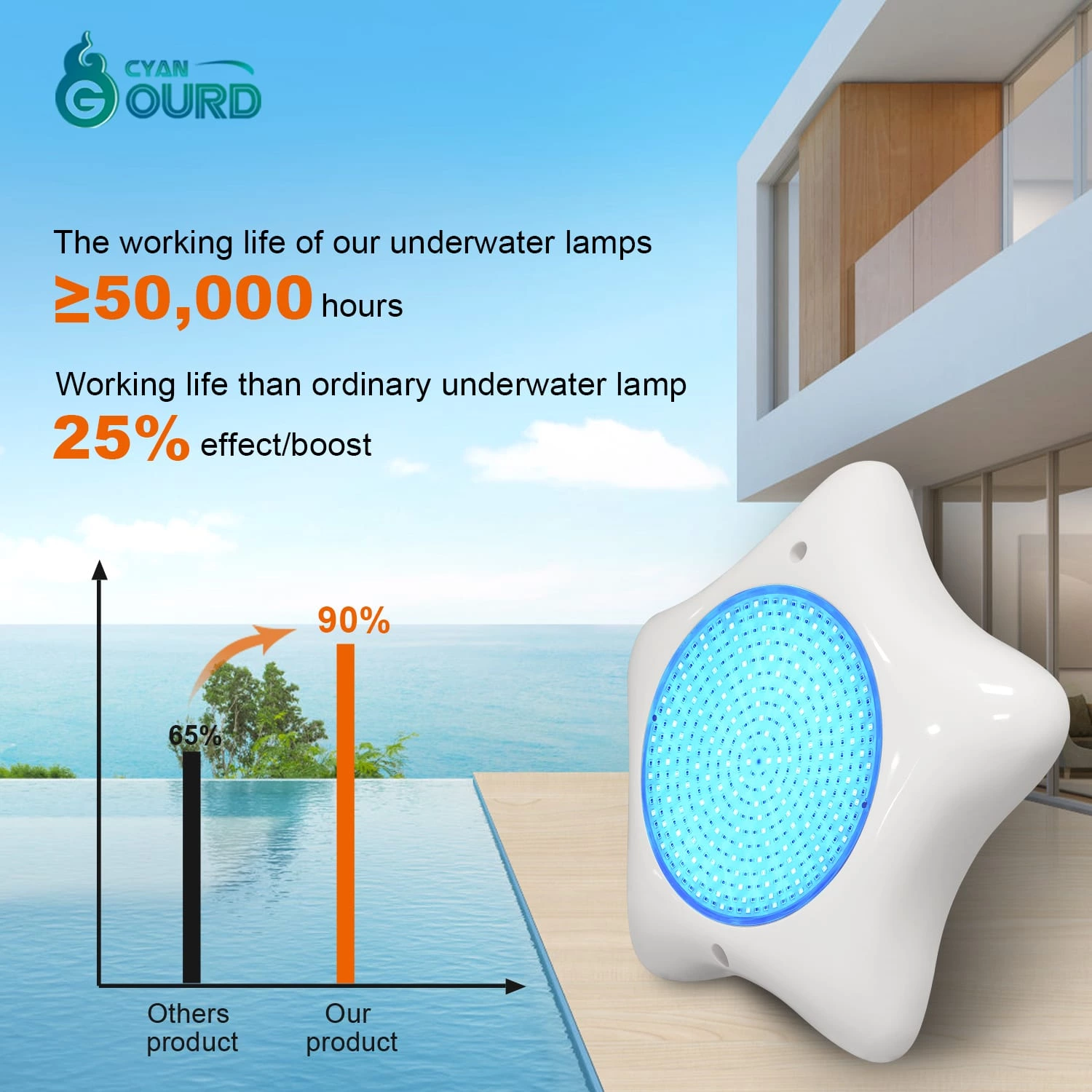
For wholesale distributors and pool contractors, the lifespan of an LED swimming pool light is a critical metric that directly influences warranty claims, client satisfaction, and long-term project ROI. While many datasheets claim 50,000 hours of operation, real-world performance often varies significantly based on engineering choices. Understanding the technical distinctions between a standard 25,000-hour fixture and a premium 50,000-hour unit allows buyers to make informed procurement decisions. This guide analyzes the structural and electrical factors—ranging from heat dissipation to resin sealing—that dictate the true longevity of underwater lighting systems.
Thermal Management and Junction Temperature
Heat is the primary enemy of LED longevity. Although LEDs do not emit infrared radiation like incandescent bulbs, the semiconductor junction generates significant heat that must be dissipated. If the junction temperature exceeds the manufacturer's threshold (typically 85°C to 105°C), the LED chip degrades rapidly, leading to lumen depreciation (dimming) or catastrophic failure.
Lights rated for 50,000 hours typically utilize high-conductivity aluminum substrates (PCBs) and robust heat sinks integrated into the housing. In contrast, lower-tier 25,000-hour models may rely on standard fiberglass PCBs or plastic housings with poor thermal conductivity. For underwater lights, the ability to transfer heat from the chip to the surrounding water is essential. Premium fixtures often employ 316L stainless steel bodies which act as effective heat exchangers, ensuring the internal components remain within optimal operating temperatures.
Waterproofing Technology: Resin-Filled vs. Gasket Seals
Water intrusion is the leading cause of premature failure in swimming pool lights, often occurring long before the LED chip itself burns out. The method of waterproofing is a decisive factor in whether a light lasts 2 years or 10 years.
Resin-Filled (Epoxy) Technology: This is the gold standard for achieving a 50,000-hour lifespan in underwater environments. The entire internal cavity containing the LED board and driver is filled with a specialized transparent resin. This creates a solid, non-hollow structure that is impervious to water, even if the outer lens cracks or the seal degrades. It eliminates condensation and oxidation issues entirely.
Gasket/O-Ring Seals: Traditional lights rely on rubber gaskets and air-filled cavities. Over time, thermal expansion and contraction (cycling between hot operation and cold water) can compromise the seal, allowing moisture to enter. Once moisture reaches the circuit board, corrosion begins, significantly shortening the lifespan to the 25,000-hour range or less.
Driver Stability and Voltage Control
The LED driver is the heart of the lighting system, converting incoming AC/DC voltage into the precise current required by the chips. Inconsistent power delivery stresses the LEDs, reducing their operational life.
High-longevity fixtures utilize constant current drivers (IC drivers) that regulate the electrical flow regardless of minor voltage fluctuations in the line. This protects the LEDs from spikes and drops. Lower-cost units often use simple resistor-based circuits (constant voltage), which are less efficient and expose the LEDs to greater stress if the input voltage varies. Furthermore, premium drivers include built-in thermal protection that automatically dims the light if it overheats (e.g., if accidentally turned on out of water), preventing immediate burnout.
Material Durability in Harsh Environments
The external environment of a swimming pool is chemically aggressive due to chlorine, salt, and ozone. The physical degradation of the housing can lead to seal failure and subsequent light failure.
316L Stainless Steel: Essential for saltwater pools and long-term durability. It resists pitting and corrosion significantly better than 304 stainless steel. A corroded housing can compromise the IP68 rating.
UV-Resistant PC/ABS: For plastic lights, the quality of the polymer matters. Cheap plastics yellow and become brittle under UV exposure and chemical attack, leading to cracks. High-grade UV-stabilized Polycarbonate (PC) maintains structural integrity, supporting the 50,000-hour target.
Comparison: Standard vs. Premium Lifespan Factors
The following table outlines the technical differences between standard commercial-grade lights and premium long-life fixtures typically sourced for high-end projects.
| Feature | Standard (25,000 Hours) | Premium (50,000 Hours) |
|---|---|---|
| Waterproofing | O-Ring / Gasket Seal | Fully Resin-Filled (Solid State) |
| Heat Dissipation | Fiberglass PCB, Plastic Housing | Aluminum PCB, 316L Steel Body |
| Driver Type | Resistor-based (Constant Voltage) | IC Driver (Constant Current) |
| Cable Quality | Standard PVC | VDE Certified Rubber Cable |
| Lumen Maintenance (L70) | Reaches 70% brightness faster | Maintains >70% brightness longer |
Frequently Asked Questions
- 1. What does the L70 rating mean regarding LED pool light lifespan?
L70 is the industry standard for measuring LED lifespan. It indicates the point at which the light's output has depreciated to 70% of its original brightness. A 50,000-hour rating means the light will still produce useful illumination (70%+) after that duration, not that it will burn out completely.
- 2. Why do some LED pool lights fail well before 25,000 hours?
Premature failure is rarely due to the LED chip itself. The most common causes are water infiltration due to poor sealing (IP68 failure), driver failure caused by voltage spikes, or overheating resulting from inadequate thermal management in the housing design.
- 3. Does the color of the light (RGB vs. White) affect lifespan?
Generally, no. However, RGB lights require more complex control systems. If the controller or the internal DMX/remote receiver is not of high quality, it can fail before the LED chips. High-quality resin-filled RGB lights maintain the same 50,000-hour durability as single-color versions.
- 4. How does saltwater impact the lifespan of LED pool lights?
Saltwater accelerates corrosion on metal components. If a light uses 304 stainless steel or lower-grade screws, electrolysis can destroy the housing, leading to leaks. For saltwater pools, 316L stainless steel or high-grade ABS/PC fixtures are mandatory to ensure the light reaches its rated lifespan.
- 5. Can voltage drop affect the longevity of the lights?
Yes. Significant voltage drop causes lights to dim and can strain internal drivers that attempt to compensate. Using proper wire gauges and ensuring the transformer supplies the correct 12V or 24V AC/DC at the fixture point is crucial for maximizing the operational life of the system.